Logo

search

  • Home
  • Books
  • Presentations
  • Reviews
  • Blog
  • Schedule
  • Tutorials
  • Bio
  • Contact Us
Posted by Dr. Mac on Nov 23, 2017 in Interview, WWI

Interview with Historian and Author Peter L. Belmonte

Recently, I had a chance to ask WWI Historian Pete Belmonte about his latest projects, history and genealogy.


1. What is your latest project?

I’m continuing to research and write about immigrants from the Province of Cosenza, with Volume 3 almost finished. It’s a challenge on several levels. First, it is hard to find information for many of the men. Often the only indication I have that a man was a WWI veteran is the 1930 census which shows veteran status; but that’s not always accurate, and I’d like to find corroborating evidence in such cases. Ancestry.com makes it easy to find information on some men. Men who lived in New York or Pennsylvania, to cite just two examples, will have their statement of service cards on Ancestry.com, and Pennsylvanians have their Veteran’s Compensation application there, too. It may take some digging, but you can generally find something.
Second, it’s hard to know when to stop and put the draft copy to bed. I keep digging, and I keep finding men who should be included. It’s essentially a genealogy project. It combines immigration, social, and military history. I’ve curtailed the amount of strictly genealogical information in each entry because of space considerations and because I wanted to focus on the military history of the men.
And third, the topic is so broad — there were thousands of men from the province who served — it just seems overwhelming. I’ve documented more than 1300 men, but I’ve published material in the two volumes for only about 400 men.


2. What got you interested in your latest project?

It started as a genealogy project. I had traced my family back to the early 1800s in an area in Calabria in southern Italy. I knew most of the surnames involved and where they settled in the United States. Some of my family settled in Kenosha, Wisconsin, where there was a large “colony” of families from this Calabrian area. I went to the Simmons Library in Kenosha, to conduct some research, and their vestibule is beautifully decorated with the names of all the men from Kenosha who had served in World War I etched into the marble walls. Looking at this monument, I identified at least 50 men with names that originated in “my” Calabrian area; furthermore, I identified at least two men who were related to me, cousins of my grandparents. As I researched further, I dug up more information; I then expanded to try to find men who settled in other areas, most notably in Chicago. After twenty years, I identified and collected information on 140 men from two villages who served in the US military during World War I. After writing that book, I expanded my search to try to document men from the Province of Cosenza, the larger area that the men hailed from.y


3. What records should genealogists be using that they probably are not?
I don’t really know what most genealogists are using. For my work, I rely heavily on Ancestry.com. Once you get used to the methods of research, it almost develops into a rhythm of checking the various sources for, in my case, military service. In that regard, I found that many immigrants were naturalized while serving in the military during WWI. By checking passport applications, 1919-1925, I’ve found many cases where the man’s naturalization was annotated on the application, and that points to a specific time and place of military service. Maybe that’s all I can find for a given man, but at least I have something!


4. Did you have a favorite unusual case/find during this research?
I found poignant stories about men who were killed in action. By using the Burial Information Files from NARA I’ve found examples of confusion among surviving family members as to the desires for the final disposition of the body. I’ve found men who were badly wounded and listed as killed in action; men who were prisoners of war. Best of all is that I have found a few cases where I can get either first or second hand accounts — usually brief — of the serviceman. And it’s always great when family members send me scans of photos of the serviceman in uniform.
Also, as a military historian, I’m interested in some of the more unusual units some of the men served in. Labor companies, administrative units, an Army ship repair unit, etc.; I’ve very interested in those histories.


5. Have you considered what your next project will be?

I’m going to continue to research and write about the Cosenza US WWI veterans. Other than that, I’m working on papers and articles for either the Journal of the Company of Military Historians, of which I’m a member, or for presentation to various historical society conferences. Some topics I’m working on: US Army Air Service construction units in England in World War I; an article about the first US military members killed in action during WWI — a German airplane bombed a US Base Hospital in September 1917 killing four men; and an obscure topic: a study of men from Racine, Wisconsin, who were drafted into the Army during the week before the war ended (I have a reason for such an odd topic!).
As far as a purely genealogical project, I want to self-publish a book containing the history of each of my distant relatives who served in the US military during world war one. This will combine my love of family history and military history. By comparing family trees with other researchers, and by using DNA matches, I’ve been able to find about 20 men who are distantly related to me and who served in the military during the war. Bear in mind that these are, for the most part, distant cousins, but such is the obsession of the historian and genealogist!

Peter L. Belmonte retired from the US Air Force after having served for twenty years, first as an enlisted man and then as an officer. A veteran of Operation Desert Storm, he holds a master’s degree in history from California State University, Stanislaus, and a bachelor’s degree in mathematics from Purdue University. He has published articles, book chapters, reviews, and papers about immigration and military history and has been a college adjunct instructor of history.
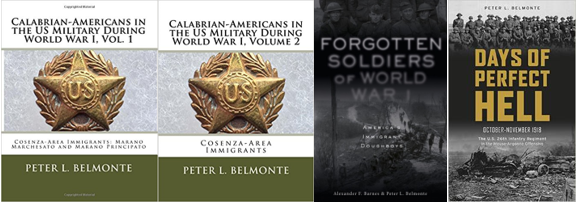
Pete has written five books: Italian Americans in World War II (2001), Days of Perfect Hell: The U.S. 26th Infantry Regiment in the Meuse-Argonne Offensive, October-November, 1918 (2015), Calabrian-Americans in the US Military During World War I, Volumes 1 and 2 (2017), and America’s Immigrant Doughboys: The Forgotten Soldiers, 1916-1918 (with Alexander F. Barnes, forthcoming).
He currently works for the Department of Defense and lives with his wife and children in Illinois.

People can find out more about his books at: www.amazon.com/author/peter.belmonte

Thank you, Pete!
Read More
Posted by Dr. Mac on Nov 18, 2017 in Military research, Useful Tips, WWI

Researching Virginia WWI Ancestors

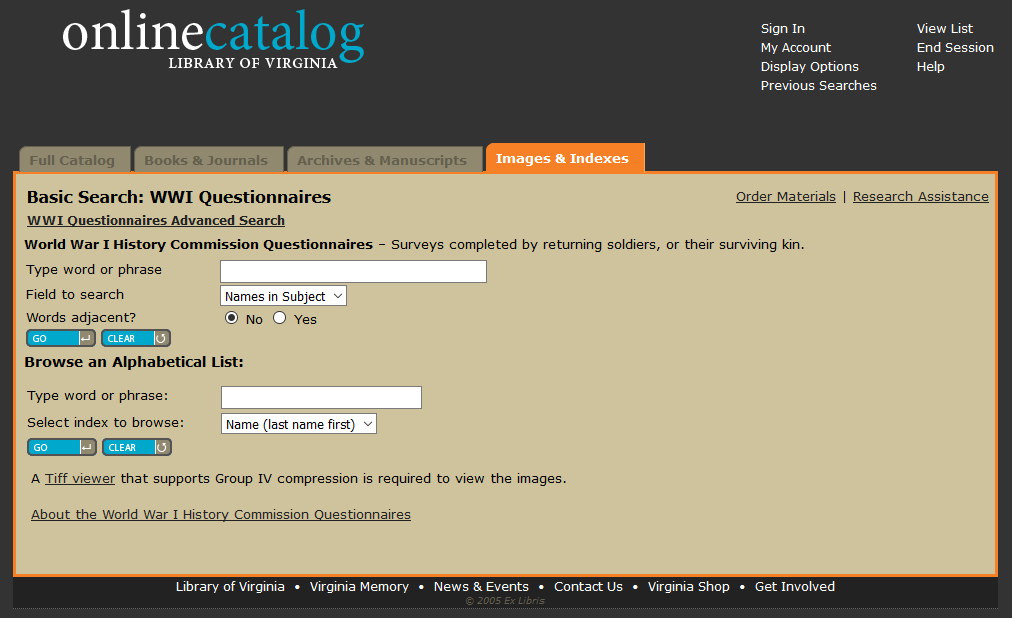
As you may know from my lectures and book, it is important to find your WWI ancestor’s military organization. An online way to find out about your Virginia WWI Ancestors is to check the WWI questionnaires posted at the Library of Virginia.

For this example, I searched for a record for SGT Earle Davis Gregory. He was the only Medal of Honor winner in WWI from Virginia.

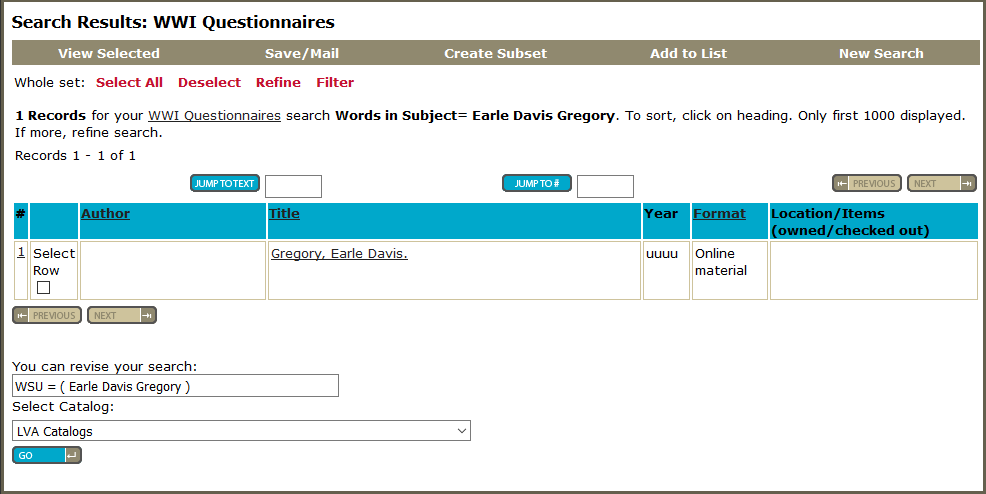
WWI Library of Virginia Search Results

Click on the name to find out more about the record.

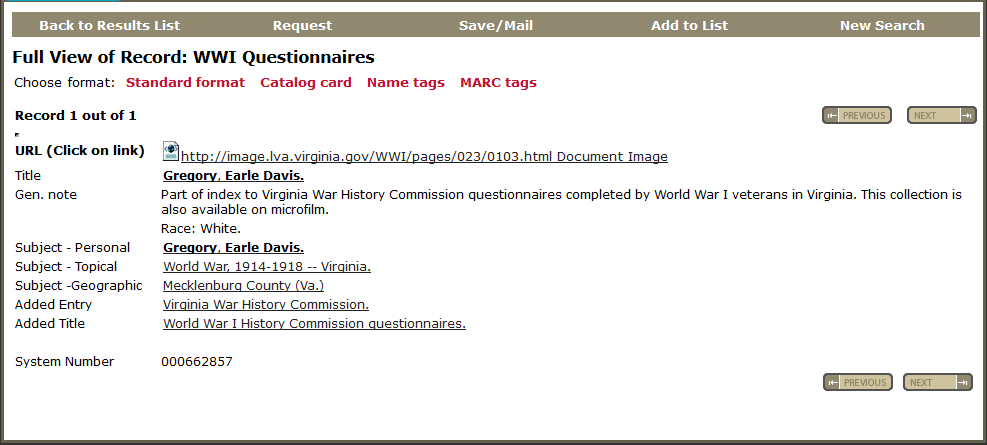
WWI Library of Virginia Search Results

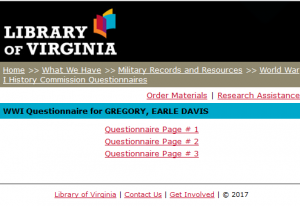
A window pops up with links to look at or download the survey pages

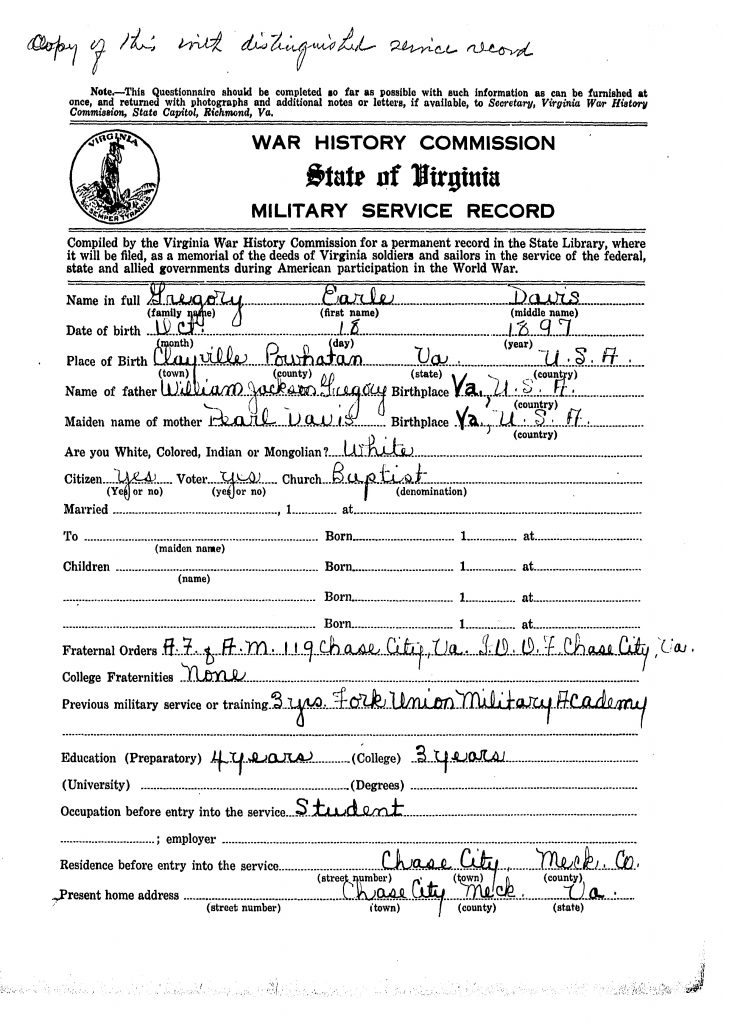
This record is his personal survey.

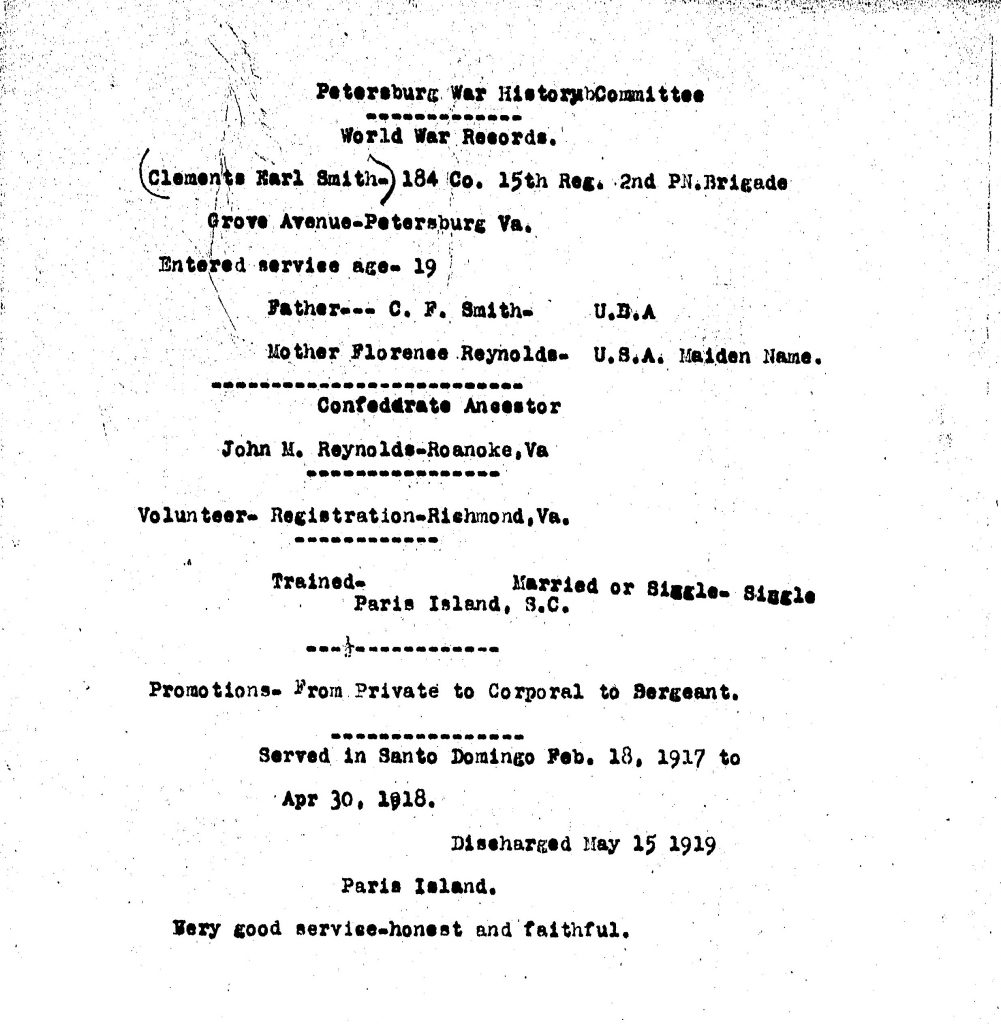
While searching, I found this record with information about the soldier’s service, an ancestor, and his mother’s maiden name.

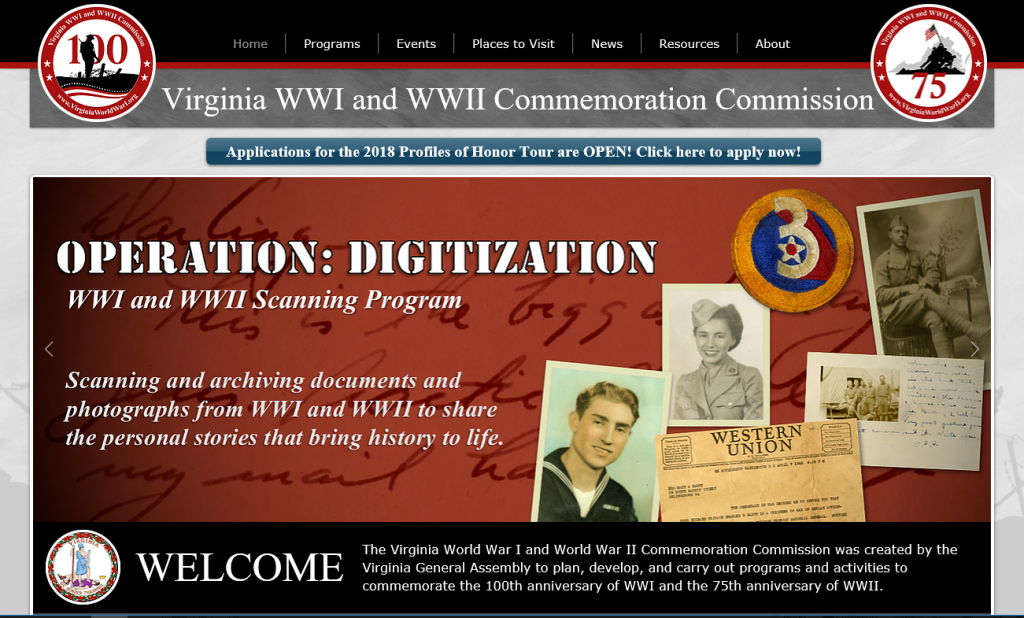
Virginia’s WWI and WWII Centennial Commission has resources that may help  you learn more about Virginia in the World Wars. On this website you can find WWI Profiles of Honor Stories.

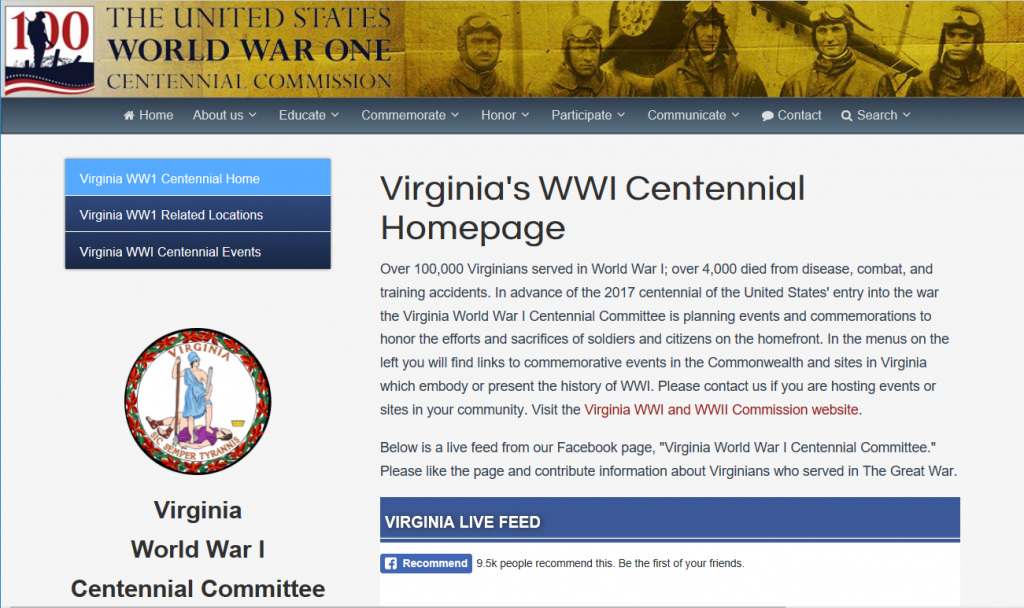
Be sure to check out the resources on the WWI Centennial Commission Website for Virginia.


Read More
Posted by Dr. Mac on Nov 15, 2017 in Genealogy Education, Military research, Useful Tips, WWI

The Edward Jones Research Center

The Edward Jones Research Center is the archives of the WWI Museum and Memorial, located at the Museum’s lowest level.

This Research Center holds some resources that may help with your research.

For example, there are 23 volumes of “Official Roster of Ohio Soldiers, Sailors and Marines”. Their holdings include volumes from several other states and even counties that published books listing all the men who served in the Great War. In these books is an entry for each service member, listing an abstract of his service. The entries contain the same data that is in the NY Service Abstracts.

Since the most of the personnel files were burned in the National Personnel Records Center, these books would be invaluable for researchers who do not know their ancestors’ military organization.

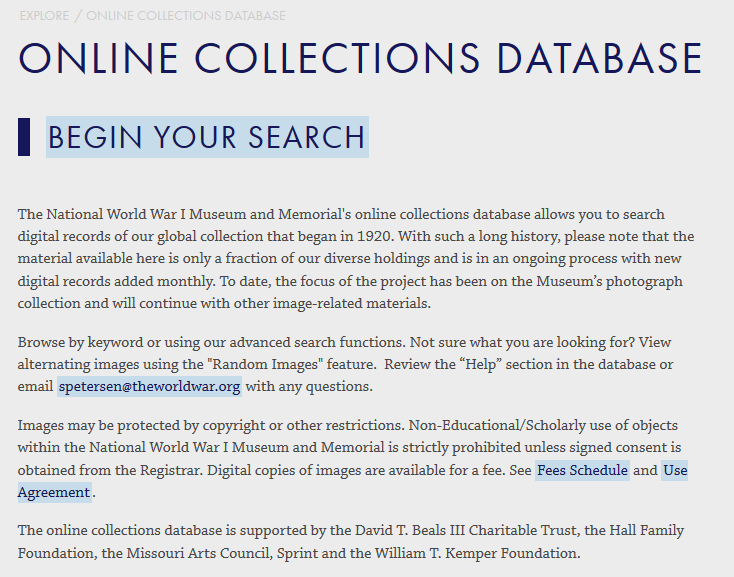
You can perform an online search of the collections at the World War I Museum and Memorial website

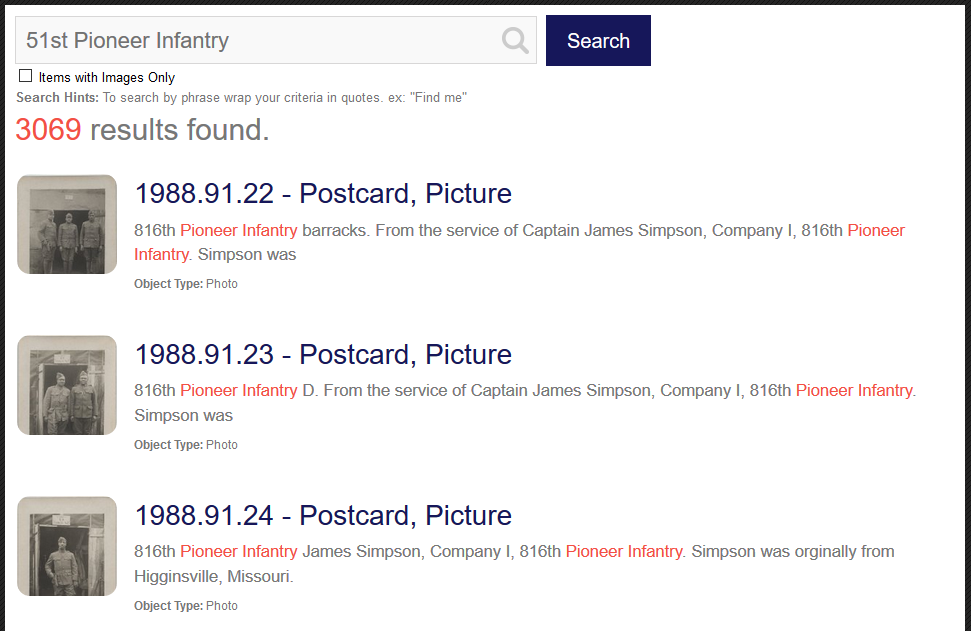
Select “Begin Your Search” and enter your keyword. In this example, I entered: 51st Pioneer Infantry.

The search returned items relating to the Pioneer Infantry, with over three thousand results. While it is great to know that there are many items about the Pioneers, my search terms needed to be more specific.

I decided to use quotes to be more specific: “51st Pioneer Infantry”, and received no results.

Next, I searched for the term: 51st Infantry

The results included the British Expeditionary Force (BEF) 51st Brigade and Col. Moses N. Thisted’s book, “Pershing’s Pioneers”.

My best tip: Be sure to contact the archivists before your trip to see what else might be available, or what suggestions they might have.

You will probably find a copy of “Researching Your U.S. WWI Army Ancestors” on the shelves.

Save

Read More
Posted by Dr. Mac on Nov 8, 2017 in Military research, Useful Tips, WWI

WWI Military Organizations: Finding More

So, you used the service summary cards or the U.S. Army Transport Service records to find your WWI soldier’s military organization. Now you want to find out more.

As much as it pains me to say, sometimes jumping into Google does not yield too much. Recently, I had a situation like that.

The organization in question was the 60th Engineers. It was proving very difficult to find much information about them.

So, I asked an historian, Peter Belmonte, for some ideas. Peter is the author of two volumes (so far) of “Calabrian-Americans in the US Military During World War I”, and “Days of Perfect Hell: The U.S. 26th Infantry Regiment in the Meuse-Argonne Offensive, October-November 1918”, and co-author of other books about WWI.  (His books are available at Amazon, and he has generously agreed to a future interview for this blog.)

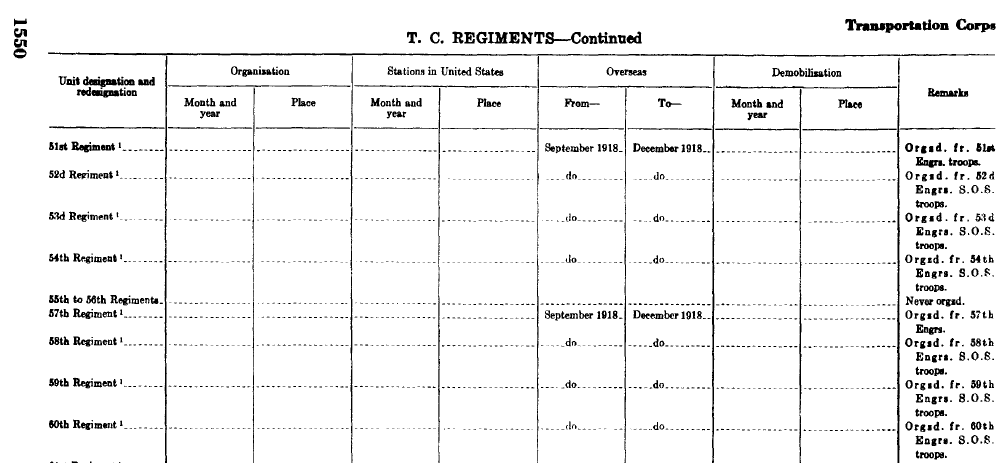
Peter recommended the “Order of Battle of the United States Land Forces in the World War, Zone of the Interior: Directory of Troops Volume 3, Part 3 contains Chapter V, Directory of Troops“. This reference shows when the organization was established, its stations in the U.S. and place of embarkation and the dates it served overseas.

The entry for the 60th Engineers appears on page 1336 of Volume 3. They were a standard gauge railway operation battalion, and the same month that they arrived in Europe, September 1918, they were converted to the 60th Regt T. C. The engineer corps railway units had converted to the transportation corps.


Following this thread in the same reference, we find that the 60th Regiment of the Transportation Corps served overseas from September to December 1918. The S.O.S. troops provided Services of Supply.


Having this information also gives you another avenue of searching, records for the 60th Regiment Transportation Corps.

The lesson to learn here is if you cannot find much information about a military organization, do a little digging to see if it might have been redesignated or reorganized.


Save

Save

Save

Save

Read More
Posted by Dr. Mac on Oct 21, 2017 in Genealogy Education, Military research, Useful Tips, WWI

4 Steps to Begin WWI Research For A Country (Liberia)

This post will cover the four initial steps to research the participation of a country (non-U.S.) in WWI. At a recent talk about ancestors in the U.S. military, a very enthusiastic genealogist asked me a question: how could he research his Liberian WWI ancestor? Questions like this make me think, and make me want to learn more.

These first steps help you get oriented by learning more about the topic.


1. Google

Start with Google. Search for terms that combine your country name with “WWI” or “World War One”. You may get lucky and find your ancestor’s name, but more likely you will find context information.

Example results for Liberia were:

  • Liberia in World War I
  • Liberia from 1912 to 1930
  • Declarations of War (Great War)

(Note: the date for Liberia’s declaration of war in on this page was incorrect)


2. Google Books

Use Google Books to learn about books that will be useful to your research. Some of the books may allow you to download them in entirety; others may provide snippets. For books that are available on Google Books, there are links to locate the book in WorldCat or to buy them. Remember that an unlikely book may contain material that will help you.

Look for information about relevant events. Uncovering dates and places is always helpful. Make a list of what you learned.

Example books for Liberia:

  • Area Handbook for Liberia
  • The Annual Messages of the Presidents of Liberia 1848–2010: State of the Nation Addresses to the National Legislature
  • THE LITERARY DIGEST History of the World War Vol. 1
  • World War I: Encyclopedia, Volume 1


3. FamilySearch Wiki

Check out the materials on the FamilySearch Wiki for the country.

Use the FamilySearch Wiki entry for Liberia to learn as much as you can about Liberia and its records. This page also contains a link to go social. The link for Military Records is currently a space holder, and has no content.


4. Make a Timeline

Now that you have the basic facts, you can rearrange them in chronological order to create a timeline as the backdrop for what you find out about your own ancestor. If the date is unknown for a fact, then place the item where it makes sense, but do not record a date for it.

Some of the information from the Google search and Google Books:

  • In 1912 six black U.S. Army officers came to Liberia to train and command the Liberian Frontier Force
  • Daniel Edward Howard was the President of Liberia from 1912 to 1920
  • ¾ of Liberia’s trade was with Germany in early 1914
  • German trade ended with the war
  • German submarine blockade in WWI reduced to almost nothing all trade between Liberia and Britain, France and the United States
  • Prior to the declaration of war ,Liberia had broken off diplomatic relations with Germany
  • Liberia was pressured by the U.S. to declare war on Germany
  • Liberia declared war against Germany on 4 August 1917
  • Liberia was an Entente Belligerent
  • There were 400 in the active military including militia, volunteers, police
  • When Liberia joined the Allies, the property of German nationals was liquidated and the money used to compensate for the loss of revenue.
  • A German submarine shelled Monrovia in June 1918
  • Liberia sent troops to France during WWI (date unknown)
  • Liberian troops in WWI did not see combat
  • Liberia received war relief funds (Liberty Loan)The U.S. Government advanced funds to the Republic of Liberia during the peace negotiations after WWI.  The amount was $26,000 (in three payments) and $9,610.46 accrued interest ($35,610.46)

Liberia is going to be a tough country to research. It may be worth contacting regional archives, and schools in the area for other research ideas.

Read More
Posted by Dr. Mac on Oct 5, 2017 in Genealogy Education, Military research, WWI

Researching Maryland WWI Ancestors

In this blog, our books and talks, you may have seen the New York Service Abstracts of WWI Military Service in my examples. Have you looked for what your state has to offer? As I come across more of these resources, I plan to post information about them in this blog. This post describes a useful starting place for those who are researching Maryland WWI service members.

To locate an abstract of your Maryland WWI ancestor, consult the two-volume book set, Maryland in the World War, 1917-1919; Military and Naval Service Records. Vol. I-II. Baltimore, MD, USA: Twentieth Century Press, 1933.


These volumes contain abstracts of the service of Maryland WWI service members, but the beginning of the book contains valuable information about Maryland in WWI and a list of abbreviations.

You can use WorldCat to search for these books at a local library, or you can find a digitized copy of the books and the records on the web.

Ancestry.com has created a database from these volumes, Maryland Military Men, 1917-1919. (The other related data collections may also be useful in your research.)

Use your own Ancestry.com account, or access it from a public library, a Family History Center or at NARA.

If you do not have access to Ancestry, or you have an interest in the additional information in the volumes, you can view them online at Hathi Trust.

Maryland in the world war, 1917-1919, Volume I A-J

Maryland in the world war, 1917-1919, Volume II J-Z

You can scroll through these online document to find pages of interest and download individual pages without logging in.  However, you need to login as a Hathi Trust partner to download the whole document. Look on the left of the browser window for the links to download the page.


There is a possibility that the Maryland’s World War I Centennial Commission will host these books on their website in future. If they do, I will update this post.

Save

Save

Save

Save

Read More
« Older Entries
Next Entries »

Blog

  • Top 5 WWI /WWII Memorial Day Research Resources
  • FamilySearch Full-Text Search for the Win!
  • Google NotebookLM Tutorial
  • Have You Tried Google’s NotebookLM Yet?
  • Finding WWII Rosters Online at NARA

Categories

  • A Week of Genealogy Book
  • A Weekend of Genealogy Book
  • Artificial Intelligence
  • Book Review
  • Cemetery Research
  • Census Records
  • Civil War
  • Conference
  • DNA
  • Family History Outing
  • FamilySearch
  • Genealogy Education
  • Get Children Involved
  • Greenland
  • Homestead Research
  • Interview
  • Irish Research
  • Korean War
  • Military research
  • Morning Reports
  • NARA
  • Native American
  • New Book
  • New York Research
  • Newspaper Research
  • Pioneer Infantry
  • Religious Research
  • Services
  • Speaking Engagements
  • Uncategorized
  • Useful Tips
  • Veterans Affairs
  • Webinar Review
  • Week of Talk Link
  • WWI
  • WWII

Credits

Photo by Susan Neves Fine Art Photography
WordPress maintenance plugin

We are on GeneaBloggers!

© 2026 Dr. Margaret McMahon - A Week of Genealogy | Contact Us