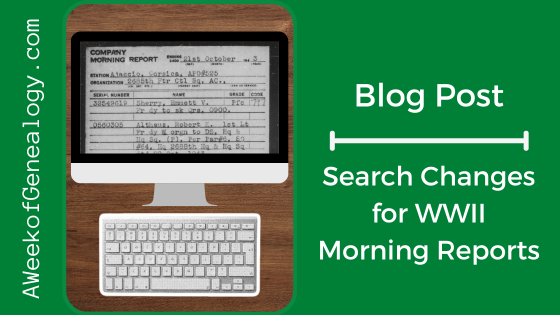
Several previous posts have been updated to reflect changes in the search experience for NARA’s Catalog. As a result, how to search for WWII Morning Reports online at NARA has changed. This post ties together new recommendations to help you find the reports you seek.
Note: At the time of writing this post, no Morning Reports for January 1945 or beyond are posted online on the NARA Catalog.
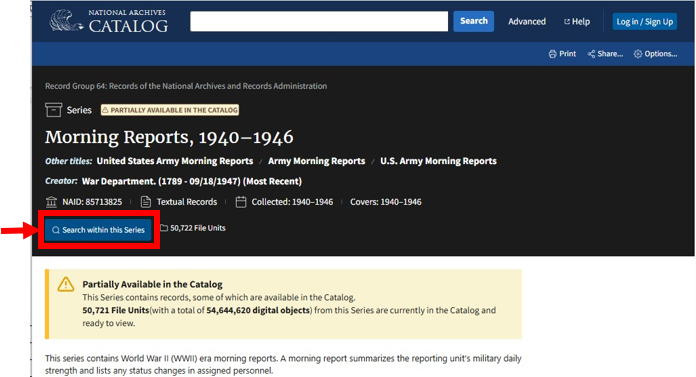
After updates to NARA’s Catalog software, I recommend searching within the Morning Report series. Click on the Search within this Series button in the Series Description page for Morning Reports, 1940-1946 at: https://catalog.archives.gov/search-within/85713825
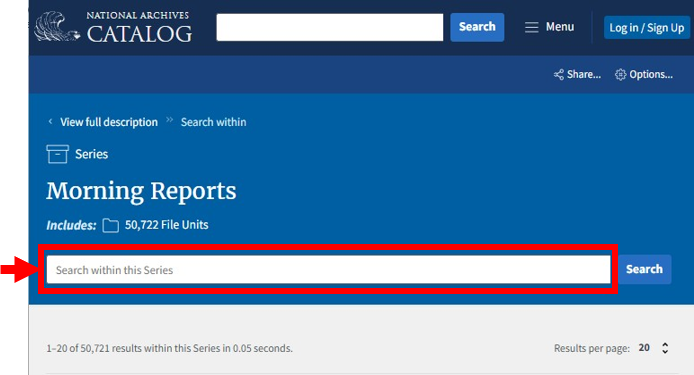
This will take you to the page where your search is limited to the Morning Reports series.
Enter search terms or search phrases within double quotes in the Search within this Series box. Be sure that the double quote marks are straight, not curly. One thing that is different from past recommendations is that Boolean terms such as AND no longer work. The search terms or exact search phrases that are within quotes are just listed one after the other, which is a little easier.
Remember that you need to stay in that same tab of the browser to view links to where the search terms have been found within the results.
Remember to be flexible in your searches, and to try different terms.
Be looking for a revised edition of my Morning Report book very soon!
The way that you search the NARA Catalog has changed.
NARA has made changes to the backend of how Catalog searches are implemented. The change means that a search using Boolean operators between more than two phrases within double quotes will result in an error screen.
More simply explained, if you have been using quotation marks and Boolean operators (e.g. AND) in your searches, don’t! Strip out all operators and quotes because multiple search keywords are now automatically interpreted as having an AND between them. That means the search results will have all the keywords in them.
In the past, where I might have used in the search bar:
“Morning Reports” AND “500th AAA” AND “Greenland”
I would NOW enter this is the search bar:
Morning Reports 500th AAA Greenland
For all the search terms you find, remove the double quotes and the Boolean operator AND and you should be error free.
As we pause to remember those who made the ultimate sacrifice while serving our country, consider learning more about those in our family.
After some thought, these are the resources I recommend to get you started or move you farther along on your research into WWI and WWII fallen service members. There are links to our blog posts with how-to’s for researching military members who fell in WWI and WWII. There is also a link to our post about an archived reference about America’s wars. With the link to the partially digitized WWII NARA record series for WWII deaths, think about how you might use the files even if the specific file you seek has not been digitized yet. Take what you learn from these resources as directions to dig deeper into more detailed sources.
Yes, many of the US Army personnel records were lost in the 1973 fire, BUT the original records that were used to construct them were not. WWI Death Files / WWII Individual Death Personnel Files (IDPF) are discussed in this post.
In addition to basing a story on WWII Morning Reports, this post describes what records were consulted that added to the story. The resources that were used are listed.
The NARA Catalog contains the IDPF files that have begun to be digitized. These files contain the records that were generated and correspondence about the dead WWII service member. In the case that your ancestor’s file has not been digitized, you might still choose to search these files.
You can search from the main catalog for “Individual Deceased Personnel Files” AND a name (or variations) in quotation marks for a mention of them in someone else’s file. If they died on a ship, you might find locate a file for those who died on the same ship and read the common information that would be in all their files, which should include the names of all the personnel involved
and insert an individual’s name or name of a ship, using search terms such as:
“Individual Deceased Personnel Files” AND “USS Helena”
For context search for those who died in the same location. For example a search from the NARA Catalog:
“Individual Deceased Personnel Files” AND “Greenland”
returned digitized files for individuals who died on USAT Dorchester. These files included details about the ship and its sinking. First person sworn statements from survivors are also included in this file.
BONUS!
Do not forget to search the Veterans Legacy Memorial to find those interred in veterans cemeteries in the US and abroad.
As a reminder, I search from the main catalog page at https://catalog.archives.gov/ so that I can benefit from the links to the search terms in the results. To see if more Morning Report are available I search for terms such as: “Morning Reports” AND “October 1944”
This time there were results! I kept searching, and Morning Reports up to December 1944 are available. (Search terms: “Morning Reports” AND “December 1944”) I did check for any from 1945, there were no results (yet!).
Of course, I did search for my father, by name and by serial number. This time I did find a mention of him. My brother was the first to know of this find, grateful that this was not a middle-of-the-night call!
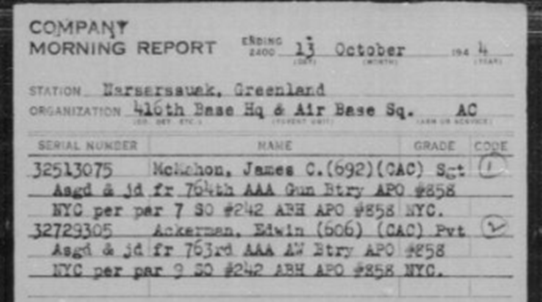
For tonight, I will share that SGT James C. McMahon appeared in a Morning Report for 13 October 1944, still in Narsarssuak, Greenland. July 1944 had left me with a cliffhanger, and this record provided data about two military organizations with which he served after the 500th AAA Gun Battalion left Greenland.
I will post about my continuing research as I use Morning Reports to reconstruct my father’s WWII service. From here, I will be busy moving forward and backward in time to track what was happening in Greenland.
Thank you to NARA! Good luck searching, and let me know how you do!
Have you every heard that you should be using Morning Reports?
A book has finally arrived to show how you can travel back in time through locations and events, day by day, with a U.S. Army soldier or organization during WWI or WWII military service. With Morning Reports, you can overcome and potentially go beyond burned Army personnel files! Pursue references for a specific soldier, then leverage daily records when not named or identified.
This book introduces techniques for locating Morning Reports and what is and is not included. WWI and WWII formats are described in detail, with examples allowing the reader to experience the WWII Morning Report language and abbreviations by utilizing the web, Fold3 (WWI) and the NARA catalog (WWII). The reader will discover tips for locating elusive reports and strategies for working around missing records. Useful case studies combine reports across parts of a military organization and place a soldier into the context of history.
This book contains a bonus chapter about the daily reporting for other branches of the military!
Historians will find the search techniques and pointers to additional records useful as they track a soldier or organization through a world war.
If you are interested in having Dr. McMahon speak at your society about Morning Reports, or other presentations, please contact us: https://aweekofgenealogy.com/contact-us/
Although it was not directly about my father’s service in Greenland, I learned a lot about the place reading Greenland’s Icy Fury by Hansen, who was part of the Ice Cap Detachment stationed in Greenland during WWII. These brave few men battled the elements and topography to provide weather information to the Allied Forces about the north Atlantic and Europe. In the book there was a mention of a soldier taking his own life in Southern Greenland (p. 3). I wondered about the circumstances, how these isolated men might have come to have this knowledge, and if perhaps this might have been a story that changed as it was repeated until it reached them at a later time. I also wondered if this soldier had been in my father’s Battery (Battery A, 500th Antiaircraft Artillery Gun Battalion).
Using the NARA Catalog, I searched for the Morning Reports of the 500th AAA Gun Battalion (shown in WWII Morning Reports using the NARA Catalog). Remember that when you traverse these records in ascending image order, you travel through them in reverse chronological order. In other words, as you go forward through images using the arrows next to the image number, you go backwards in time.
When I download Morning Reports, I typically download all of the Morning Reports for a whole military organization for each month, rather than just focusing on certain days or just when an ancestor’s name appears. There are common experiences within the units that may be expressed differently or in a different level of detail.
Going through the Morning Reports for the 500th Antiaircraft Artillery Gun Battalion, I located a report about the funeral service and burial of a soldier from Battery B. Battery B was stationed at Ivigtut [now Ivittuut], Greenland. Battery A, the battery to which my father was assigned, was stationed was stationed farther south in Narsarssuak [now Narsarsuaq]. Both are in the southwest of Greenland.
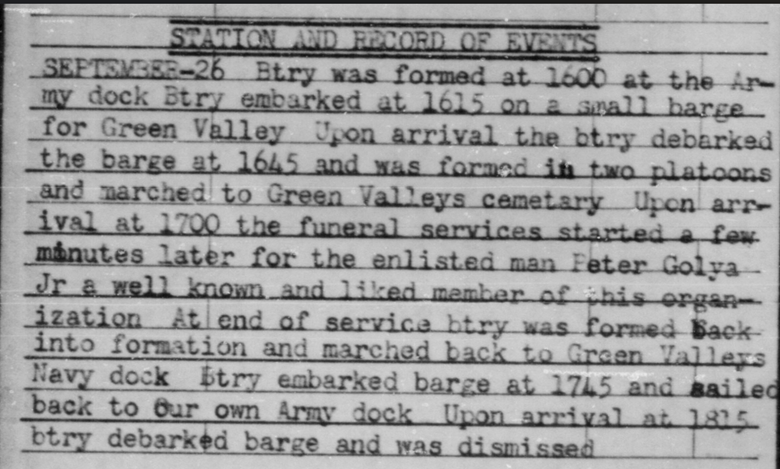
The story in Morning Report was very moving, describing the solemn ceremony that laid PFC Peter Golya Jr’s remains to rest in Greenland. The battery traveled to the the Green Valley Cemetery by barge for his funeral services for “Peter Golya Jr a well known and liked member of this organization.” The Green Valley Cemetery was listed as near Ivigtut in a finding aid for Cemetery Plat Maps in Record Group 92 (RG92) prepared by the American Graves Registration Service.
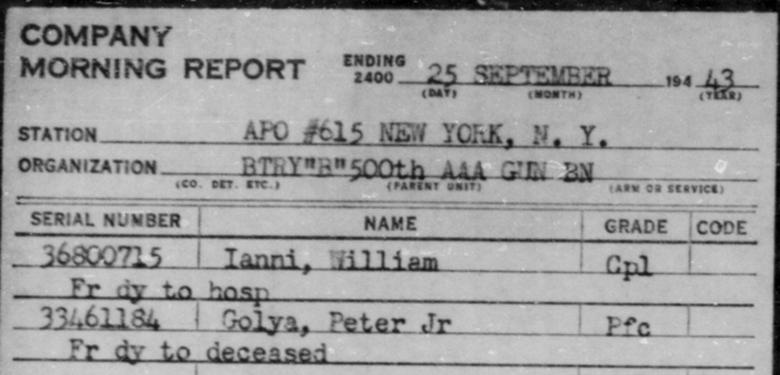
The next image sequentially (in my Firefox browser) was the Morning Report for the previous day, 25 September 1943, when not long after arriving in Greenland, PFC Peter Golya’s status had changed from duty to deceased.
I did more research into this soldier and found several records online with supplemental details. PFC Golya died as a result of a machine gun bullet perforating his head. He was 36 when he died. The hospital admission card recorded his death as being in the line of duty. In the hometown newspaper articles, his death was reported as accidental.
The hometown local newspapers contained his obituary, accompanied by a photo, and the text of the telegram his mother received. The telegram contained the date of his death, and the fact that he died in the North American area. His obituary was titled: “Dupont Man Dies Serving His Country: Soldier Last Reported Stationed in Greenland Passed Away Sept 25. In Service 7 Months.” When his remains were returned to the US, they arrived by train in 1947 escorted by a Staff Sergeant from the local area. Members the VFW Post, the American Legion, and Catholic War Vets met the train and escorted them to the fallen soldier’s father’s home. There was a military funeral, followed by a mass of requiem at his Catholic Church with the burial being in the parish cemetery.
As I located records, I added pieces of the story where I could. On FindaGrave.com I uploaded the Morning Report to the Memorial. I also created a subject page on Fold3 to collect the documents Fold3 had about him.
The records that were found pieced together a story of what happened to him and where. The Morning Reports were the only records containing details of the movement of the battery to bury him in Greenland. From the few words the reader learns about the soldier being well known and liked, and can imagine that cold barge ride, and march to the Green Valley Cemetery to bury a comrade who suffered an accidental death in the line of duty.
Resources that were located online (Note: some records can be found on multiple websites.)
NARA
Access to Archival Databases (AAD)
Fold3
US, WWII Army Enlistment Records, 1938-1946
US, WWII Draft Registration Cards, 1940
US, WWII Hospital Admission Card Files, 1942-1954
US, Rosters of World War II Dead, 1939-1945
FamilySearch
Military • United States World War II Army Enlistment Records, 1938-1946
Ancestry.com
U.S., Headstone Applications for Military Veterans, 1861-1985
U.S., Rosters of World War II Dead, 1939-1945
U.S., World War II Draft Cards Young Men, 1940-1947
A finding aid for World War II Cemetery Plat Maps in Record Group 92 (RG92) prepared by the American Graves Registration Service listing the cemeteries in Greenland
Newspapers.com
Hometown newspapers contained his obituary, and articles about the repatriation of his remains for funeral and burial in his hometown
American Battle Monuments Commission
I searched ABMC, but did not expect to find any record of his passing in this database, as there is no American Cemetery in Greenland. Through a FindaGrave.com search, I did find that his remains had been repatriated, and reinterred in the United States.
The WWII Hospital Admission Card Files are available on Ancestry.com and Fold 3. They contained only transcriptions of the Admission Cards, which including only summary data. Digging deeper into records from the hospital might not be helpful as it appears he died quickly after the injury.
A next step might be to look for his Individual Deceased Personnel File (IDPF). These records are separate from the personnel files that burned in the 1973 fire. As of writing this blog post, a small fraction of them are online at NARA, and PFC Golya’s is not among them. You can search at: https://catalog.archives.gov/search-within/297287480?sort=title%3Aasc