
From Battlefield to Abbey: Google NotebookLM and CMSRs
Have you tried the Audio Overview in Google NotebookLM yet?
A previous post described how to get started with Google NotebookLM, step by step Google NotebookLM Tutorial. This post discusses a way I have used a Google Notebook to explore a set of documents. By the way, always expect the user interface to AI products (and others) to change, with the basic functionality remaining similar.
There is always sadness in records that were created to document the injuries, ailments and suffering of U.S. veterans. They gave up a part of their lives and future to serve our country. But I wanted to see if there were ideas and connections that AI could put together to create a deeper picture of one veteran’s Civil War military service. The Rev. Fr. Thomas J. Kennedy’s military service was described in The Military Service of Thomas Kennedy.
I created a new notebook, and uploaded a set of documents about the Rev. Fr. Thomas J. Kennedy. These documents focused on his military service: his Compiled Military Service Record (CMSR), a Civil War Service Record Bookmark 4408-D-1885 for him, Carded Medical Records (CMRs), and his pension file.
The chatbot both suggested and answered questions. The numbers at the end of each statement in an answer refer to a source for the answer, and clicking on the numbers open a preview with the name of the document and which page in the document that data was located.
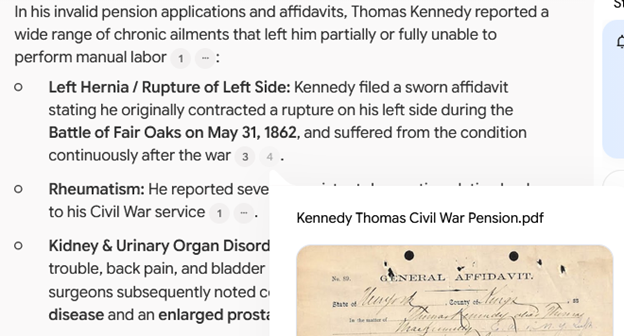
The chat responded to my questions about the contents of the files. It extracted the data regarding his prisoner of war experience, his transfer to a parole camp in Annapolis, MD, and his return to his original regiment. The medical issues contained in the files were outlined and discussed. With each answer, it embedded links that could be clicked to view which page of the document contained the data it used. There were also suggested questions at the end of each response, in case I wanted to explore avenues it had identified.
Aside from having an area set up for an AI to focus on the specific documents, the audio files have become a favorite product of mine. Of course, listening uses a different part of the brain than reading, but there is more to it. These audio programs might raise questions I have not yet asked, and share context and insights developed from the material. In this case, they connected some dots and suggested that this Civil War veteran had conditions that were consistent with traumatic brain injury. They also drew my attention to his change in height between physical exams, and suggested that might be consistent with some of his other medical issues.
I chose an Audio Overview, and Google NotebookLM generated an audio file: Civil_War_Bugler_Turned_Trappist_Monk.mp3
The audio overview featured contextual information about the parole system worked and the role of a bugler in communicating battlefield commands. Soldier Kennedy’s bugle was intended to be heard above the chaos of the battlefield. The idea that he went from creating the loudest noise on a battlefield to living in the silence of a monastery is an interesting thought to ponder. That also prompted me to consider that there is perhaps an analogy that his responsibility for transmitting tactical orders might have had a parallel to his religious calling. (Although he lived with Trappist monks in his final days, there is no evidence that Kennedy became one.)
The generated podcast and I have both surmised that the Abbey of Gethsemani may have been able to offer what 1901 version of end-of-life palliative care. Further research is needed to confirm this.
There were several mistakes in the transcript, but none was significant compared to the insights the AI had developed. One example was describing a period of time as 30 decades (300 years) rather than 30 years.
What needs to be pointed out is that this set of uploaded records is only representative of the endpoints of his journey from soldier to the end of his life, not his journey. Although he lived with the Trappists Monks at the end of his life, there is no evidence that he was one.
There is more to learn from these records as well as from continued research into the Rev. Fr. Kennedy’s life. As a collateral relative, he has already shed light on my own direct ancestors’ lives, and there is no doubt that future discoveries will illuminate more of their story.
When you try the Audio Overview in Google NotebookLM, let me know how you do.
Things to remember about use of AI
There may be mistakes. Do not ever use the output of an AI as your final product! As you might keep hearing, use AI as an assistant during your research, not as a researcher.
To learn more about these records
Claire Klusken’s blog, The Twelve Key, where she has links to a series of articles about Civil War records at https://twelvekey.com/civil-war/
NARA’s webpage about Compiled Military Service Records at https://www.archives.gov/research/military/army/compiled-military-service-records
Special thanks to the Ancestors and Algorithms Podcast for the inspiration and techniques to use for this project.