Aliens in Their Own Country, Stateless Women and AI

Blog Post Banner Aliens in Their Own Country, Stateless Women and AI

While researching the registration of aliens in the U.S. in 1940 and learning how to obtain an ancestor’s AR-2 form covered in Born in Brooklyn: An Alien in WWII, I wondered if other countries might have had similar laws at the time. (NOTE: This blog post is not intended as definitive, and is not intended as legal advice.)

I am always looking for resources to help to investigate topics. AI has become a resource to find and interpret credible sources. As a genealogical assistant, an AI can explain concepts to me and help me reason through how these laws applied to my ancestor.

The first sections describe the prompts I used, then a list of do’s and a couple of do not’s, with the last section summarizing what I learned about Canadian and British laws, and how they affected my ancestor.


I asked AI to help me research similar laws in other counties, specifically in Canada and Britain:

I am interested in learning more about women’s citizenship in Canada and UK when they married an alien

What followed was an informative conversation, where I asked for sources and clarification. ChatGPT provided relevant details and provided sources for the laws.

I then asked the AI to help me reason through how these laws affected my ancestor. Since these people have been dead for many years, I used initials. I could have used single initials or “Person 1” or “Person A” to be less precise. ChatGPT had asked if I had a specific woman I wanted to research, and this time I my prompt was a response:

K.S. (woman) was born in the U.S. and married J.Y. (man) born in Scotland. They married in New York City in 1913. J.Y. died in 1929. K.S. remarried in 1932 to J.G. (man) who born in the U.S.

ChatGPT outlined the timelines of the laws and how K.S. was affected by them, and asked for clarifications at times.


When writing the previous blog post I asked:

Can you find me a source that urged people who thought that they might be aliens to register in 1940? Give me the source. If you find a poster of flyer from the time, show me and of course, give me the source where it might be found

The response contains some very good sources for me to use, including the regulations published by the Department of Justice/Immigration and Naturalization Service published its Regulations Governing the Registration and Fingerprinting of Aliens in the Federal Register, including the section number.
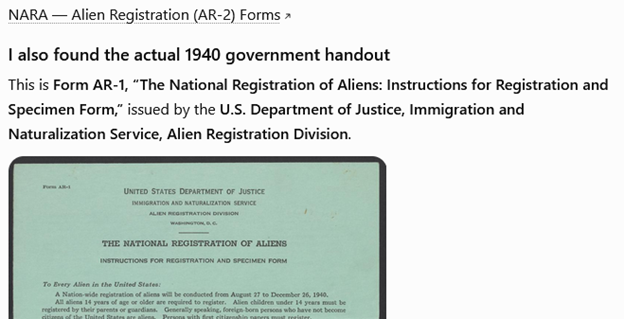
and The National Registration of Aliens: Instructions for Registration and Specimen Form,” issued by the U.S. Department of Justice, Immigration and Naturalization Service, Alien Registration Division.


Do

  • Include in the prompt “Cite sources”
  • Anonymize people’s names for privacy
  • Ask for explanations of terms and passages that may not be straightforward
  • Ask for help to find additional sources

Do not

  • Hesitate to ask “Where in the document did you find this information”
  • Forget about peoples’ privacy when using AI tools

What I learned about Canadian and British laws, and how multiple countries’ laws affected my ancestor:

Like much legislation, the laws surrounding women’s citizenship were complicated. Repeated subsequent legislation would later their status.

What I learned was that women’s situations were similar to the United States in Britain and Canada (although British law considered that there were other countries where a woman to automatically become a citizen of her husband’s country). The following is a simplified version covering some of the key events; you will want to dig farther into the details for your specific ancestors.

Britain’s Naturalization Act of 1870 tied a women’s nationality to her husband’s nationality. The British Nationality and Status of Aliens (BNSA) Act of 1914 explicitly stated, “the wife of a British subject shall be deemed to be a British subject, and the wife of an alien shall be deemed to be an alien.”  The 1914 British Nationality and Status of Aliens Act allowed women who were widowed or divorced the status of British subject.  

Until 1947 there were no Canadian citizens because Canadians were considered British subjects. That meant before 1947 a Canadian woman marrying a foreign national, became an alien. Before15 January 1932, a woman married to a man who naturalized became a British subject even if she was not named on his certificate, and a married woman who was a British subject lost her nationality if her husband became a citizen of another country. After 15 January 1932 a women marrying an alien lost her British nationality if her husband’s country considered her to be a citizen. In 1947, the Canadian Citizenship Act gave women separate citizenship that they retained separate from their marriage. The “Lost Canadians” did not have their citizenship returned automatically. It was legislation in 2009 that retroactively returned their citizenship. In 1948 UK women were given separate citizenship. (In 1947, a woman who married a Canadian did not automatically derive her citizenship from her husband.)

On 22 September 1922, the Cable Act repealed the 1907 Expatriation Act, and women no longer lost their citizenship based on their husband’s nationality. But for women married before then, the situation was more complicated. In 1936, divorced or widowed women could repatriate via an application, and upon its approval taking an oath of allegiance. As of 2 July 1940, an act allowed women to repatriate no matter what their marital status was. The repatriation oaths could be filed in any county, state or federal. They might be separate in a court’s naturalization records (as in Westchester County, NY).

Consider this situation pre-1932: a woman born in Canada (British subject) marries an American man in 1930. By Canadian law she loses British nationality. But after the U.S.  Cable Act of 1922 did a foreign woman did not automatically become an American citizen when she married an American. This woman would be stateless, neither British, nor American.

The widowed Kathryn remarried in 1932 to an American citizen, so she did cease to be a British subject. Since this was after 1922, her marriage to an American citizen did not automatically make her an American citizen. Therefore, legally she may have been in limbo, neither British nor American. She may have been stateless at that time.

In 1933, the situation was remedied for Kathryn and other women in her situation. The British Nationality and Status of Aliens Act 1933 changed the rule. “Under the 1933 Act, a woman would not be deemed to have ceased to be a British subject automatically on marriage to an alien (or when, during the marriage, her husband ceased to be a British subject) if she did not actually acquire her husband’s nationality” (Resumption (History)). Retroactively, women in Kathryn’s situation, who had not gained citizenship through their marriage, regained their British subject status.

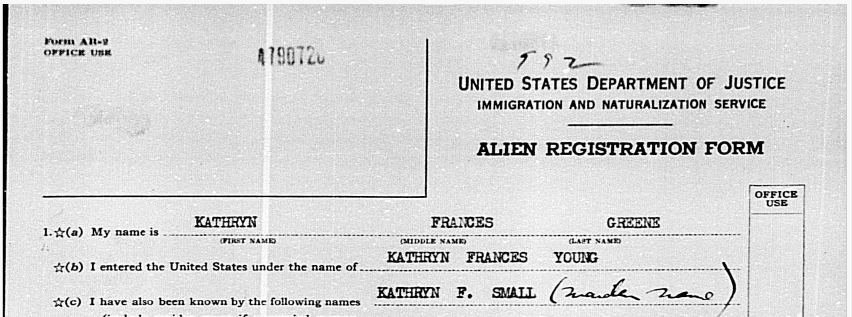
On 20 December 1940, Kathryn filed an Alien Registration Form, reporting her citizenship as “Great Britain” (without any notation in the margin that “Applicant doubts need for registration”).

Alien Registration Form line 4.

Learning More

When Saying “I Do” Meant Giving Up Your U.S. Citizenship by Meg Hacker https://www.archives.gov/files/publications/prologue/2014/spring/citizenship.pdf

Historical background information on nationality (accessible), Updated 22 May 2023. https://www.gov.uk/government/publications/historical-background-information-on-nationality/historical-background-information-on-nationality-accessible

Resumption (History) [Archived]. https://assets.publishing.service.gov.uk/media/5a81dce5ed915d74e3400763/resumption.pdf

Ethnic Origin And Nativity Of The Canadian People, EIGHTH CENSUS OF CANADA, 1941. https://publications.gc.ca/collections/collection_2017/statcan/CS98-1941M-35-eng.pdf (See document pages 114–115 describing the national status of married women.)

Good luck with your research and let me know how you do!
Born in Brooklyn: An Alien in WWII

Researching women can be challenging. Research married women can be more challenging. Researching women who marry an alien can become more complex. Researching this topic was intriguing and challenging. Then, finding a way to explain its complexities clearly and understandably made this blog post take considerably longer to write than I had anticipated. I learned a lot, and hope you will too! Additional resources to learn more are listed at the bottom of the post.

I always try out databases, and there was only one person I could think of in my family tree who might not have been a citizen in the 1940’s. She married a subject of Great Britain. After her Scottish husband’s death, she had remarried a U.S. citizen, so I did not think I would find her in the database of people who registered under the Alien Registration Act of 1940. (Other countries had similar laws: stay tuned for another blog post about that.)

Surprisingly, her name appeared.

On 6 Aug 1913 my great aunt married James Howie Young, a man who lived in Scotland in her parent’s home. They sailed off to travel through Europe, then live permanently in Glasgow, Scotland. James died in 1929. Later, she married a citizen, John J. Greene in 1932.

The Expatriation Act was passed on March 2, 1907, and at that time “any American woman who marries a foreigner shall take the nationality of her husband.” On 22 September 1922, the Cable Act repealed the 1907 Expatriation Act and women no longer lost their citizenship based on their husband’s nationality when they married. But for women married before then, the situation was more complicated. In 1936, divorced or widowed women could repatriate via an application, and upon its approval taking an oath of allegiance. As of 2 July 1940, an Act allowed women to repatriate no matter what their marital status was. The repatriation oaths could be filed in any county, state or federal. They might be separate in a court’s naturalization records (as in Westchester County, NY). What we do know from the AR-2 is that even though a statutory path to repatriation existed by 1936, Kathryn apparently had not completed it by the date of her 1940 alien registration (20 December 1940).

My first reminder that she had been affected by the Expatriation Act was when her citizenship was listed on a ship manifest for a cruise from Bermuda in 1931. She was shown as a citizen of Britain. (Race or people: German; Returning Resident; Place of birth: Brooklyn.) The record was definitely for her, as she lived at the same address on Stuyvesant Avenue in Brooklyn as the person she was going to join, her mother. (This was also a known family address.) The German race or people was interesting; her late father was a German immigrant to the U.S. who naturalized.

Further searching uncovered that she had returned to the U.S. in 1929 on SS Laconia. Her nationality (country): Britain; Race or people: American. She was a widow, with her nearest relative in the country she departed being her mother-in-law, and she was going to join her mother in Brooklyn. She had been in the United States from 1928 to 1929.

After watching Researching Immigrant Ancestors: Alien Registration (AR-2) Forms Elizabeth Burnes and John LeGloahec in the 2025 NARA Genealogy Series https://www.archives.gov/calendar/genealogy-series/2025#Session%205, I searched for an AR-2 for Kathryn. (Use the link to view the video of the presentation, and to download the presentation slides.)

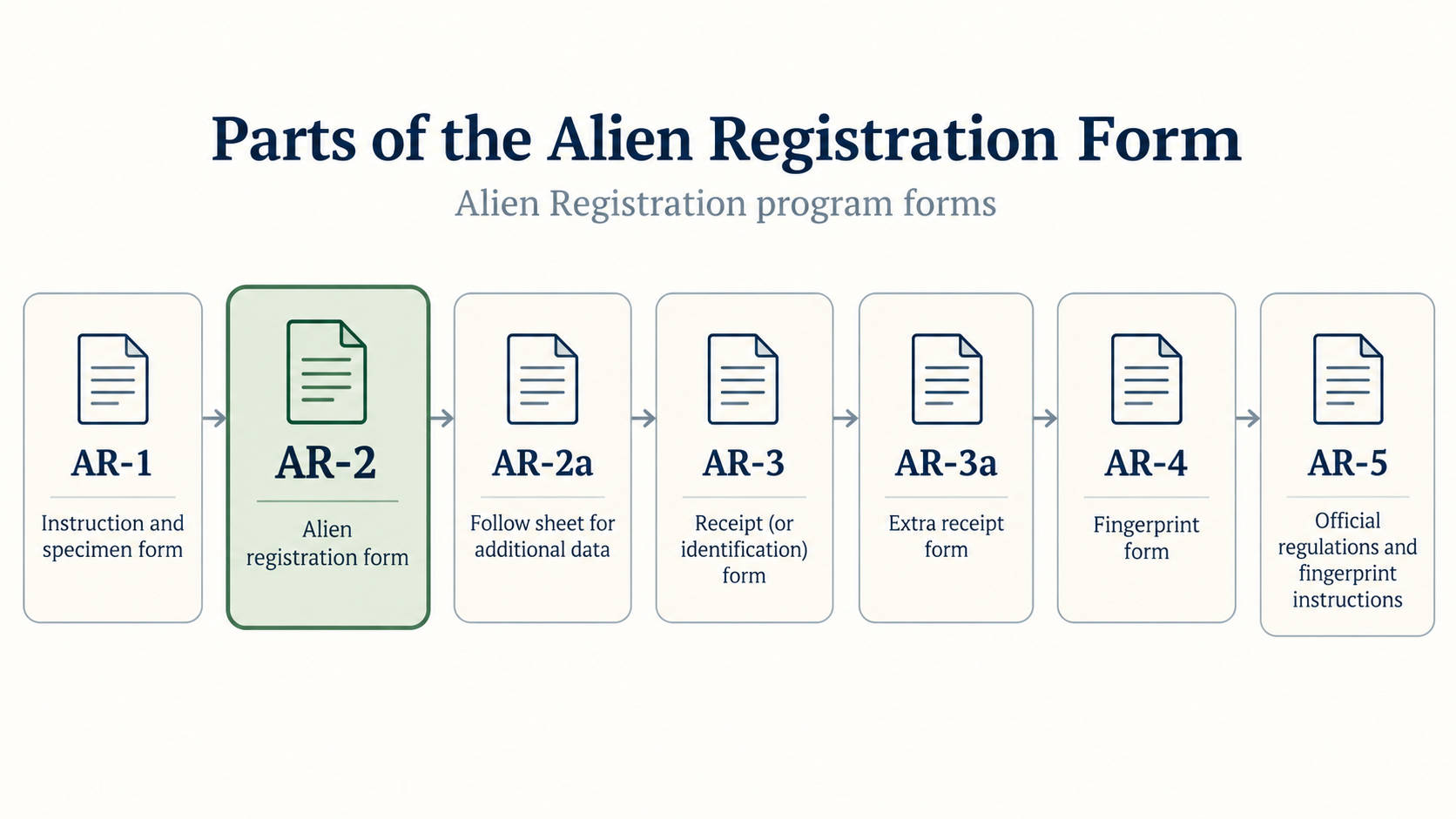
The parts of the Alien Registration Form are shown below. NARA has the AR-2 itself, but additional parts of the form may be found in A-Files or may no longer exist.

Alien Registration Form Parts

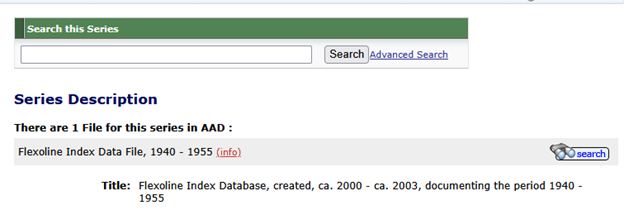
I searched from Access to Archival Databases (AAD) at https://aad.archives.gov/aad/and selected the Flexoline Index Database, which is the finding aid to the AR-2 forms.

Flexoline Database

Alternatively, you can go directly to the search page at https://aad.archives.gov/aad/series-description.jsp?s=5259&cat=all&bc=sl

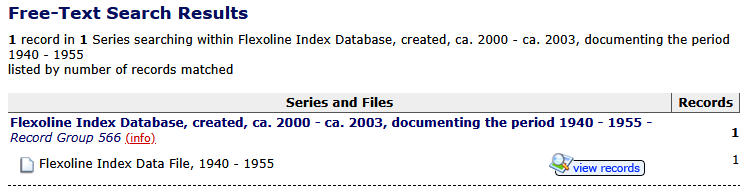
Flexoline Search

If you are having issues finding a person, remember to try advanced searches with broader information like surname and location, and alternate spellings. There were no results for either of her two married names, but there was a result for her maiden name. The use of wildcards is also an option (e.g. Kath* Small).

Search for Kathryn Small

There was only one result.

Search result

I viewed the record.

View record from search result

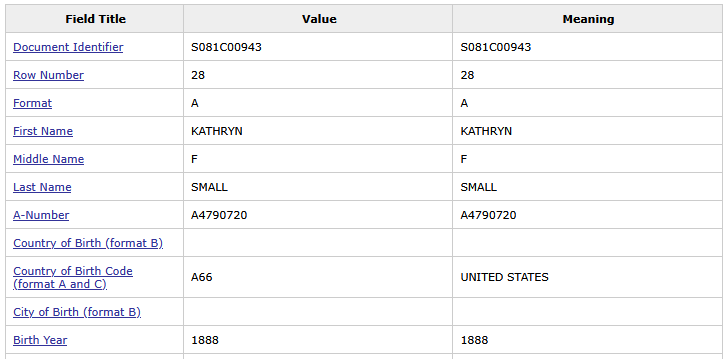
I clicked on the icon in the View Record column to see the result. (Only the top of the full result is shown below.)

Full record of search result

From the information in this search result compared to what I knew of Kathryn’s life, I was sure that this was a record for her. Alien Registration: A4790720

Using the instructions in the presentation, I used the A-number to search the NARA Catalog to see if NARA had an Alien File (A-File) for her. That search was unsuccessful.

I began the process to order her AR-2 file from NARA by sending the email that is described in the instructions at https://www.archives.gov/research/immigration/alien-registration-ar-2. This page also contains a link to sample forms. Since she was born over 100 years ago, the process was simpler than for deceased individuals who were born more recently than 100 years ago.

There was an automated email response reminding me to be sure that I had submitted the required information. I had sent the email on a weekend day, and on the next business day, a NARA Archivist responded that their search in the Flexoline Index had returned a record for Kathryn, and provided both of her married names. (Her married names were not included in the search result from the AAD.) The email also confirmed the results of my search, that NARA did not hold an A-file for her. If you find that NARA has the A-File for your ancestor, follow the instructions in the NARA video for information about how to order it.

The email contained information about how to complete the payment for the order. There is no option to pay online, so follow the instructions. Not wanting to email my credit card information, I elected to wait a couple of days to be sure the order number existed in their system, then called to my provide payment. Within a couple of weeks, a link to download the form was emailed to me. The link is advertised to only stay active for 30 days, so be sure to download it.

Kathryn’s Alien Registration Form gave her physical description, showed her profession as a housewife, and included that she had not been arrested. The date of the affidavit was 20 December 1940. People who were unsure that they were an aalien were encouraged to register, and in the Federal Register, August 14, 1940, §29.4(n), the official was instructed to write “Applicant doubts need for registration” in the margin of the form. According to the Statement by the Department of Justice paragraph in Congressional Record of the Senate, 1941, thousands of people doubted their status and registered for their own protection. Kathryn has no such notation.

AR-2 Form

Upon not finding an A-File at NARA, the suggestion is that I could possibly pursue if USCIS might still hold an A-File for her, and had not yet transferred it to NARA. What I learned from the Westchester County, NY, courthouse was that these women could have filed an Application to take Oath of Allegiance as a Naturalization Repatriation. (The database had no entry for her in that County of her residence.) USCIS may not hold an A-File for her, and searching for one incurs a cost, so I may not do this check. It is also possible that she never did repatriate.

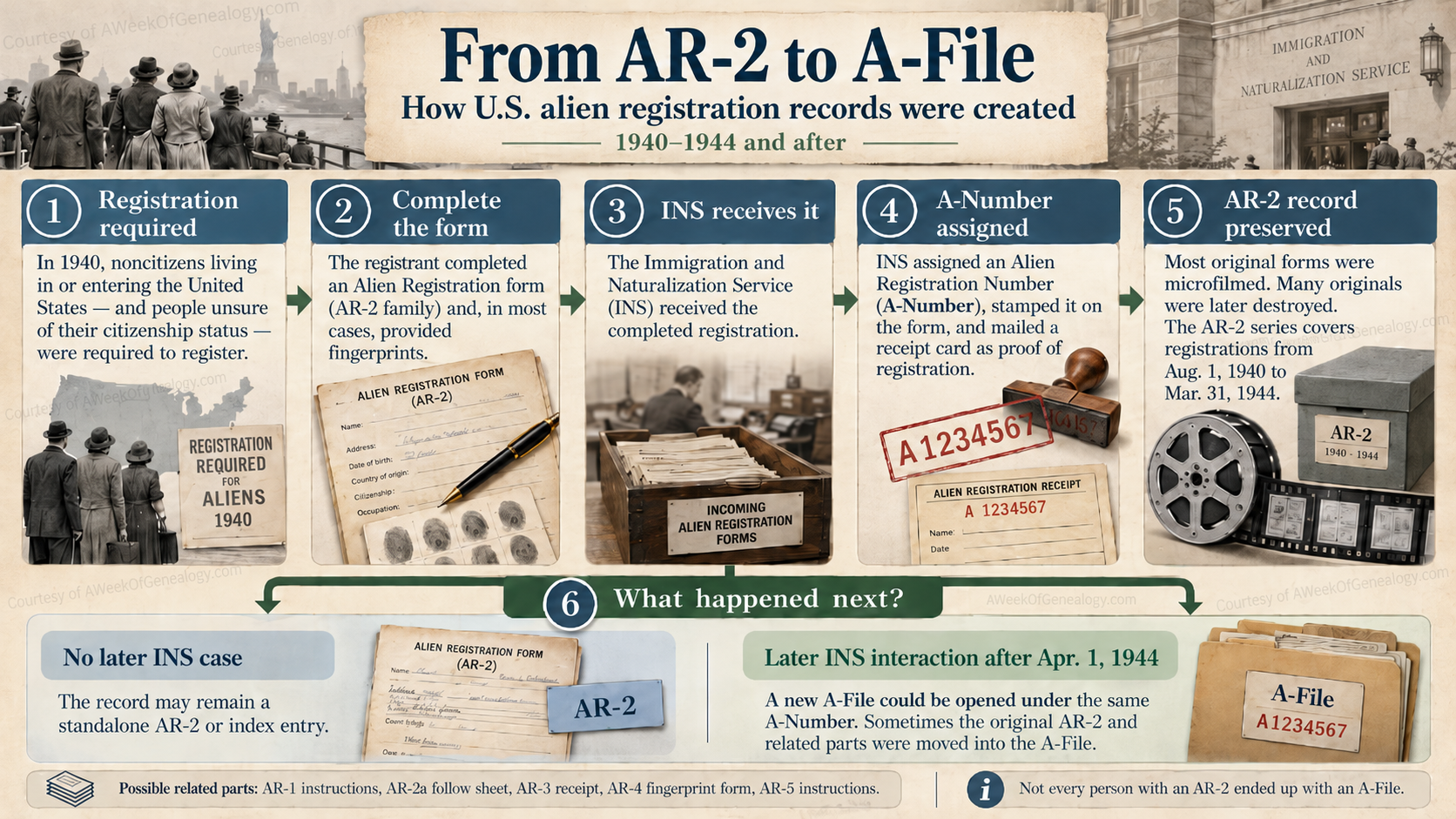
Upon prompting, ChatGPT put together an infographic about the AR-2 to A-file process using information at: https://www.archives.gov/research/immigration/alien-registration-ar-2. Google Gemini verified the information in this image using information found at the NARA AR-2 webpage.

From AR-2 to A-File

The laws concerning a women’s citizenship in these days was not straightforward, so I did a little more digging. Stay tuned for another blog post with more information about other countries’ similar laws and how Kathryn may have been stateless after her second marriage.

Learning More

Alien Registration (AR-2) Forms https://www.archives.gov/research/immigration/alien-registration-ar-2

To learn more about Flexoline files, go to https://www.archives.gov/research/immigration/flexoline

Researching Immigrant Ancestors: Alien Registration (AR-2) Forms Elizabeth Burnes and John LeGloahec in the 2025 NARA Genealogy Series https://www.archives.gov/calendar/genealogy-series/2025#Session%205

When Saying “I Do” Meant Giving Up Your U.S. Citizenship by Meg Hacker https://www.archives.gov/files/publications/prologue/2014/spring/citizenship.pdf

Westchester County County Clerk: Index for N – O https://archives.westchestercountyny.gov/county-clerk/n-o#series11

Federal Register, August 14, 1940, https://www.govinfo.gov/content/pkg/FR-1940-08-14/pdf/FR-1940-08-14.pdf (see §29.4(n) on p 2840)

The National Registration of Aliens: Instructions for Registration and Specimen Form https://digital.sciencehistory.org/works/rnpj9e5

U.S. Congress, Congressional Record, 77th Cong., 1st sess., April 1, 1941, vol. 87. https://www.congress.gov/77/crecb/1941/04/01/GPO-CRECB-1941-pt3-9-1.pdf (see Statement by the Department of Justice paragraph 3 p 2773 )

Give it a try, and let me know who you find!