5 Places to Improve Your Genealogy Skills Online

Blog Post banner 5 Places to Improve Your Genealogy Skills Online
When you want to learn more about genealogy but getting to in-person classes is difficult, online courses may be just what you need.

NOTE: Keep in mind that access to learning platforms with a library card can change over time. Course offerings can change.

NOTE: Courses are provided by a variety of entities. Some introductory courses may be offered as a starting point for certificate or degree programs.


MOOCs

FutureLearn

FutureLearn offers massive open online courses (MOOC).  Courses are free BUT you need to create a free account. You may have access to the materials only for the duration of the class, so download what you think you will need later. You may be asked to pay for a certificate of completion, but whether you choose to do so is entirely up to you.

Search for courses at: https://www.futurelearn.com/courses
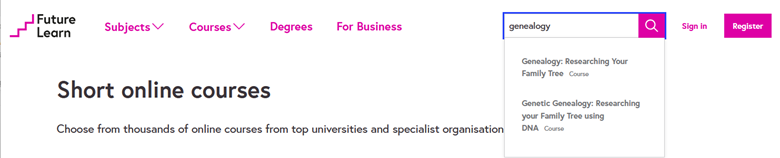
FutureLearn genealogy results

Two of the courses can be found at:

https://www.futurelearn.com/courses/genealogy

https://www.futurelearn.com/courses/genetic-genealogy-researching-your-family-tree-using-dna

Genealogy: Researching Your Family Tree by University of Strathclyde, Glasgow has a British isles flavor to it, which might be of interest to those with ancestors who originated there.

Alison.com

Alison.com offers massive open online courses (MOOC).  Courses are free BUT you need to create a free account. You may be asked to pay for a certificate of completion, but whether you choose to do so is entirely up to you. Users have the option to share a basic free learner record as proof of completion.

Search at: https://alison.com/
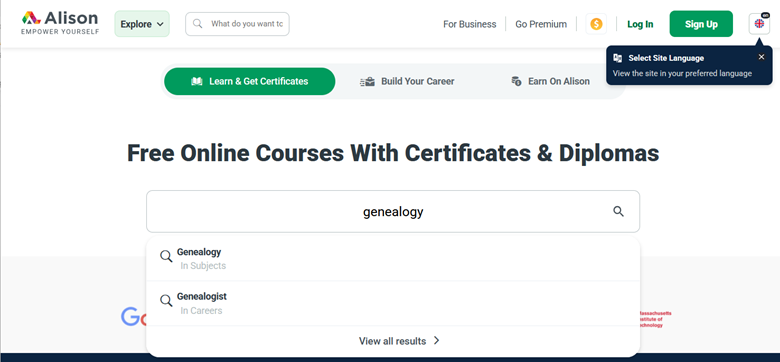
Alison.com Home Page

I enjoyed An Introduction to Irish Family History published by IrelandXO.

Alison also has free courses set out as a potential pathway to become a genealogist, which include several biology courses. (I am not sure that virology will help with becoming a genealogist, but it does sound interesting!)


Use Your Library Card To Access Resources

Check which digital resources you can access with your library card. These resources can vary by county. Here in Maryland, you can obtain a library card for any other county. Check if the counties in your state offer this reciprocity. It is important to check library subscriptions as these may change over time.

Kanopy

This streaming platform is accessible through my home county’s library. While there are many movies, it also offers online access to The Great Courses lectures. You can download the accompanying book in PDF form. There are courses about history, wars, touring countries, and more. 

Individual episodes of “Discovering Your Roots: An Introduction to Genealogy” are shown in the search results for: genealogy. Although Dr. Colletta’s class offers sound principles, even though it is a bit dated in how records are accessed. Clicking on one episode takes you to the page to use 5 of your monthly tickets for 5 days of access to the course. (through Anne Arundel County Public Library you receive 30 tickets per month.) It also has a link to access the supplemental material, which is the PDF file of the Course Guidebook that accompanies the course.
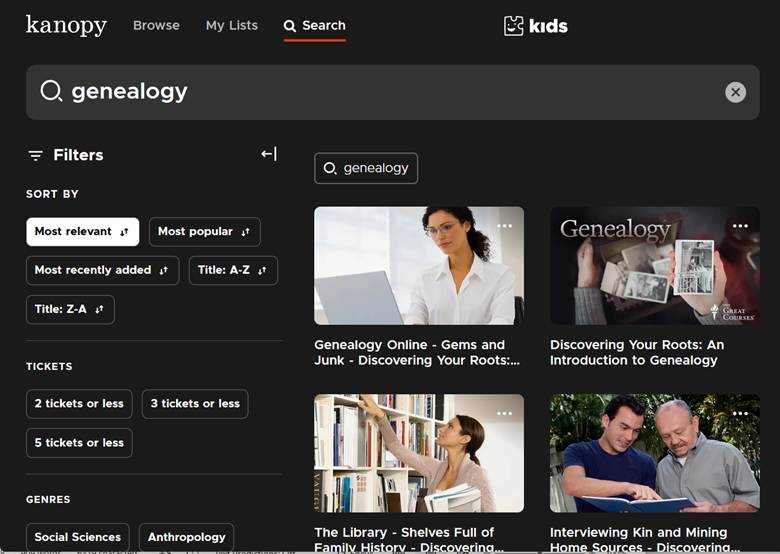
Kanopy search

FamilySearch

FamilySearch Classes in the Learning Center

I have included this resource because some of the classes are part of a course. You may have seen links to the videos listed in the individual research wiki pages. Examples are the classes in Immigration—Crossing the Pond, Ireland Beginning Research, and Strategies for Using Civil Registration in the British Isles.             

There are a multitude of classes about research in U.S. geographical areas, specific countries, the research process, and topics of interest to genealogists like paleography. You have to register for a free account to view courses. Having a free account is a great idea to access the records on FamilySearch. (Some classes, like the ones presented in Russian, are only available to Church members.) Although some classes may be slightly dated, the process and the records that are used are relevant; accessing the records themselves may now be online.

This page will give you a list of all the current classes available in the Learning Center:

https://www.familysearch.org/en/wiki/Classes_in_the_Learning_Center

To find classes of interest, you can sort the table of classes by any column or search the webpage. The last column, Country Topic, might be the most helpful to find classes to support your genealogical growth.
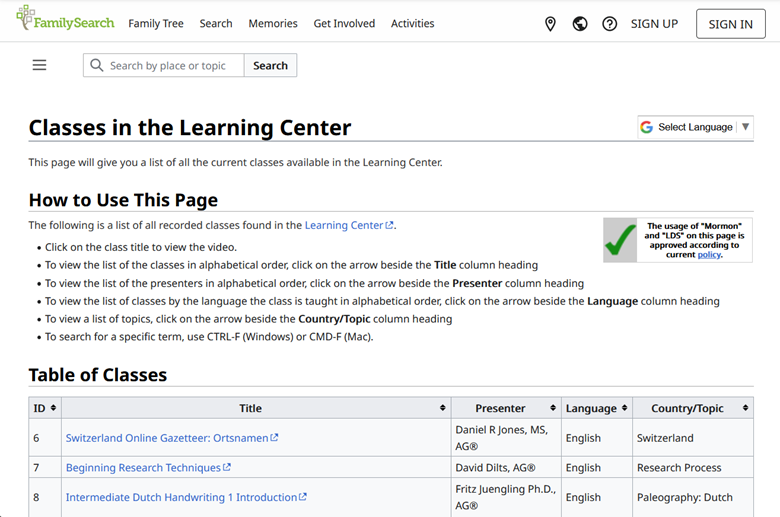
Classes in the Learning Center

OpenLearn

Although there are no specific genealogy/family history courses at OpenLearn, you can focus on developing particular genealogy and family-history skills with their courses. You can access the material without creating an account, when you register you can enroll, save your progress, and earn a free Statement of Participation.

The issue with this platform is that courses relevant to genealogists might not be located using the search terms genealogy or family history.

When searching OpenLearn, try more than just the word genealogy. Useful search terms include family history, family photographs, archives, historical records, local history, oral history, and DNA. Courses useful to genealogists are often categorized by the research skill or historical subject rather than specifically as genealogy.

https://www.open.edu/openlearn
OpenLearn Home Page

When you search, the results will contain courses, videos and articles. You can filter the results.

One course that could be of interest is Picturing the family, available at: https://www.open.edu/openlearn/history-the-arts/visual-art/picturing-the-family/content-section-0
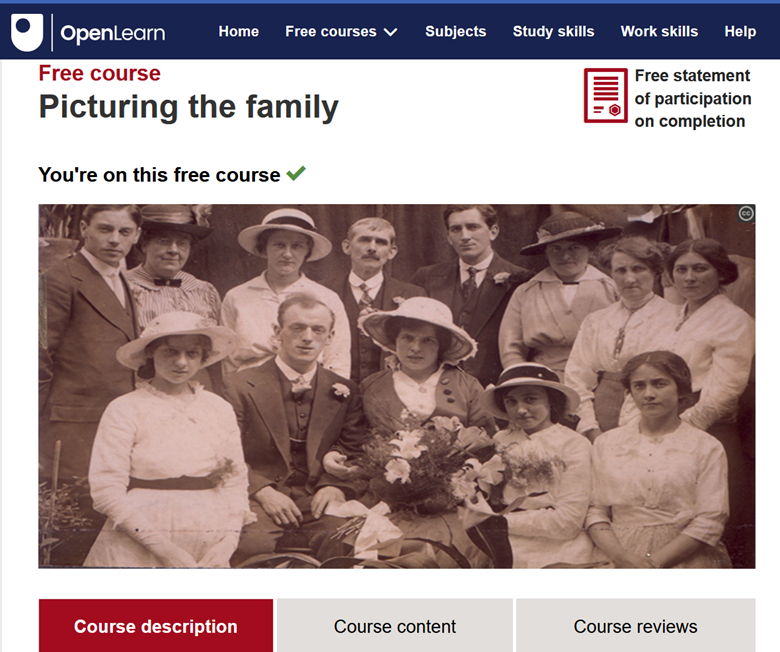
Picturing the family course page

Bonus Resource

Even though the title promises only 5 places, it is always good to have something extra. So, here is one more introductory course. By the way, look for learning materials on other genealogy websites.

MyHeritage

MyHeritage offers a 5-hour introductory course: Introduction to Genealogy Course. Each lesson walks through different topics in the world of genealogy to help you to grow your family tree. Registering for the course is required to save your progress, so you can pick up where you left off. (Registration is also required for MyHeritage users.) https://education.myheritage.com/courses/genealogy-for-beginners
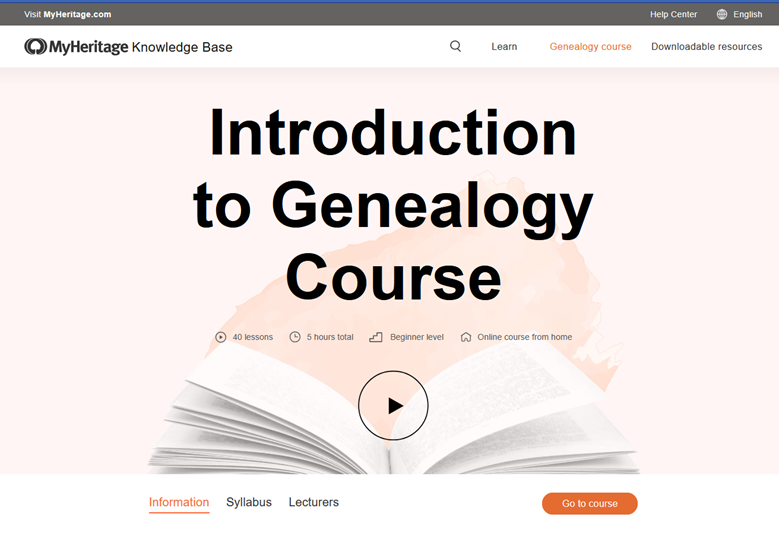
MyHeritage Intro to Genealogy page

While you are on the page, also check out the downloadable resources: https://education.myheritage.com/downloadable-resources/

Be sure to check out your county library or another county library for access to the Library Version of MyHeritage. In Maryland, with a Howard County Library System library card, you can access the Library Version of MyHeritage from home.

Keep learning!
WWII Morning Reports in PDF Files

Blog Banner WWII Morning Reports in PDF Files

My newest presentation is about finding the genealogical gold buried in WWI and WWII Morning Reports.  I have been spending time working on a companion book so that readers could a resource with them as they search for and use Morning Reports. This has been leading me to experiment with the finer points of searching for WWII Morning Reports through the NARA Catalog.

The caveats are:

1) Search from the NARA Catalog (https://catalog.archives.gov). You don’t always get links to show where the search results occur in the images within the File Unit, but searching from the Catalog (rather than within the Series) is the only way to see links at all.

Changes to how to search the NARA Catalog are described in Changes When Searching The NARA Catalog.

2) Don’t use Firefox. Use a web browser other than Firefox for searching Morning Reports. There is a known bug where Firefox display images in reverse order, and that can make things more complicated than they need to be. (I use Chrome.)

Although I have not had confirmation from NARA that PDF files are available for every Month/Year and Roll Number combination in the Morning Report series in Record Group 64, a pattern has emerged. Rather than having to download every image separately, there appears to be a way to download the images from a Roll in the form of PDF files that contain groups of 125 images. Considering the convenience of having these Morning Reports online, the time to download each image was not objectionable. Individual images can be downloaded in .tif file format, so you may choose to that option.

For context, the Morning Reports were photographed onto Rolls (Reels) of film. These Rolls were digitized. NARA split the Rolls into File Units, which are parts of the Roll having 1000 images, with fewer images in the last part of the Roll (the end of the Roll). Those parts are File Units, and are labeled with the Roll Number and have numbers like these at the end (1 of 4), (2 of 4), (4 of 5). The number after “of” is the number of parts that the Roll was divided into.

The math that follows is just one way to calculate which PDF file to download, and how to figure the page within the PDF file. This is intended to be a primitive introduction, to go through the process step-by-step.

Example: I located a Special Order containing the search term in the Morning Reports. It was in the File Unit:

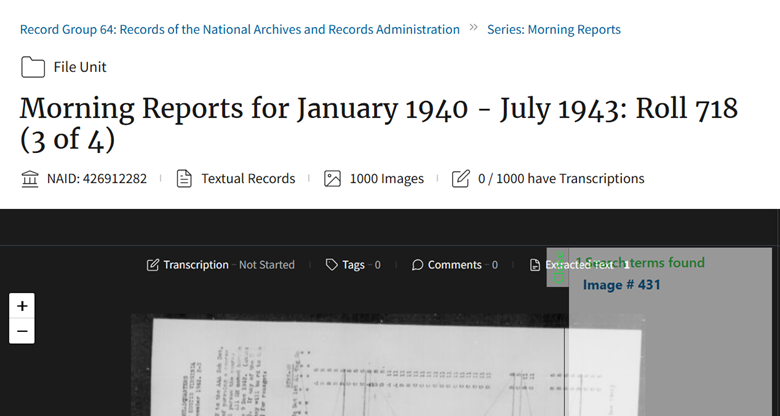
Morning Reports for January 1940 – July 1943: Roll 718 (3 of 4)

at: https://catalog.archives.gov/id/426912282?objectPage=431

Morning Reports for January 1940 - July 1943: Roll 718 (3 of 4)

I made a note of the image number, and which part of the Roll it was on (3 of 4).

I knew that:

Roll 718 (1 of 4) had images 1-1000 of the whole Roll

Roll 718 (2 of 4) had images 1001-2000 of the whole Roll

Roll 718 (3 of 4) was the image of interest to me, image number 431

I am looking for what would be image 2431 on the whole Roll.

Knowing that each PDF file has 125 pages, I divided 2431/125 = 19.45

The image would be in the PDF file ending in -20

Doing a little more math, the number of images in the previous 19 PDF files would be

19 x 125 = 2375 images

subtracting all those images from the calculated image number

2431 – 2375 = 56

I would expect to see the page I was looking at in the PDF file ending in -20, on page 56 of that PDF file

So, I searched from the Catalog for:

“Morning Reports for January 1940 – July 1943″ AND “Roll 718 (4 of 4)”

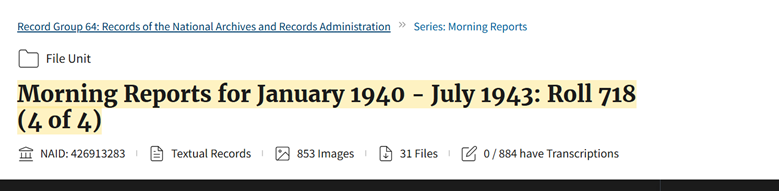
The one search results was for: https://catalog.archives.gov/id/426913283

Morning Reports for January 1940 - July 1943: Roll 718 (4 of 4)

As expected, the PDF files were posted on the webpage with the end of this Roll. I downloaded the PDF file ending in -20, on page 56.

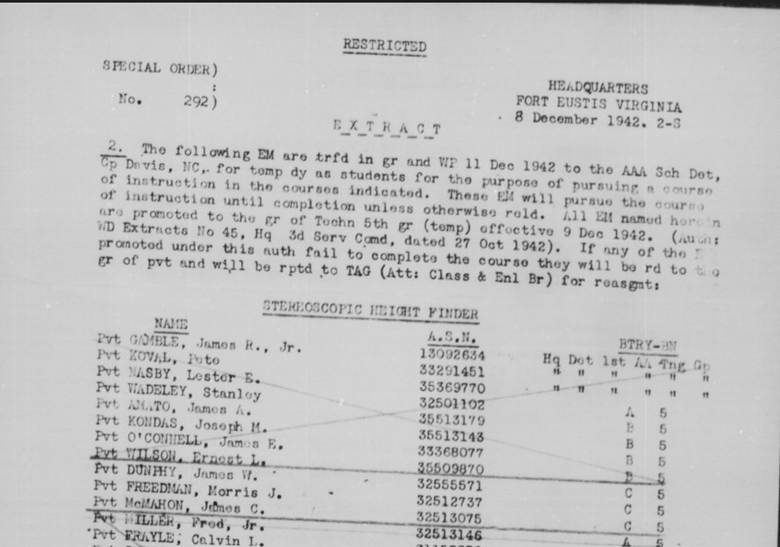
Special Order found in Morning Reports

At the Coast Artillery Replacement Center in Fort Eustis, Virginia, troops were trained in anti-aircraft artillery. This Special Order was how my father came to be trained at a school for using the Stereoscopic Height Finder at Camp Davis, North Carolina.

Remember that for the best chance to have links to where search terms appear within the parts of a Roll (File Units), is to search from https://catalog.archives.gov, and remember to view the search results within the same tab.

Good luck, and let me know how you do!

In Memoriam: Sharon Gumerove

Blog Post Banner In Memoriam: Sharon Gumerove

This past year the frequency of blog posts slowed as I processed the loss of my best friend since 8th grade, Sharon Gumerove. You might have seen her name gracing the dedications in my books, acknowledging her unwavering support of my efforts, especially in website and editing services.

Being from different boroughs in New York City, we might not have met had it not been for us attending what could be considered a magnet school, Hunter College High School. Our adventures could easily fill a book. We were part of a team publishing a science fiction fan magazine in high school and college. We drove across the country when I moved to California, long before she had her driver’s license. There were so many great times we spent together. More than that, we were family.

If our adventures could fill a book, Sharon’s acts of kindness to others could fill a library. She was a beacon of generosity, always ready to lend a helping hand. The lives she touched were undoubtedly better for having known her.

Thanks to phone calls and social media we stayed in close contact. Just before her passing, we spent countless late nights discussing uses of new artificial intelligence (AI) technologies. Her focus was on content creation for her websites and social media; my focus was about how to use AI in genealogy and to support all types of learning. We bounced ideas off each other, sharing our experiments and what we had learned. The feeling of loss echoes every time I contemplate reaching out to share a moment or inquire about her life.

Sharon had an array of plans for the future; her death was truly unanticipated. I found myself drawing on the genealogical search and contact skills I had amassed to reach out to those close enough to attend her funeral and the users of her web hosting service. She had hosted my website, and the transition, though challenging, became manageable with the skills she had imparted. She had taught me enough to manage my website; I only needed to learn about web hosting.

As we step into 2024 with hopes and plans, there’s an undeniable sadness: a realization that we are closing the book on the last year Sharon was with us. May her memory be a blessing, a testament to the profound impact she had on all our lives.

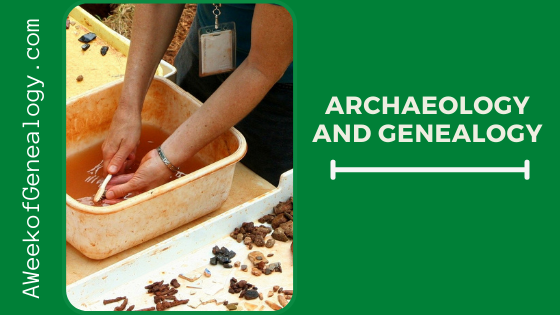
Archaeology and Genealogy

Archaeology and Genealogy

This past semester I took an introductory class in archaeology. Archaeology is part of anthropology, so the class involved more than digging. I learned that archaeology was one of the four branches of anthropology, with the other three being: Physical (Biological) Anthropology, Cultural Anthropology and Linguistic Anthropology.

Archaeology and genealogy share some similarities. Like genealogy, archaeology looks at peoples and their cultures through the physical things that they leave behind. Historical archaeology is most like genealogy because it covers the time of recorded history.

Archaeology borrows three principles from geology: the Archaeologists use principles from geology to determine time frames of artifacts: the Principle of Superposition, the Principle of Association, and the Principle of Strata Identified by Fossils/Artifacts.

The Principal of Superposition is where the oldest artifacts are at the bottom. Just as genealogists begin with themselves and work backwards to older ancestors, an archaeologist digs through layers, from newest to oldest and the story is the sum of those layers

The Principle of Association means the materials that are close together are of similar age. This reminds me of the collateral relatives that genealogists research to find answers, and cluster research.

Principle of Stratification lets archaeologists estimate the age of artifacts by the layers in which they are found. Genealogists dig through the layers of each generation to find their ancestors and families.

Digging a site is a destructive process, where genealogy is constructive. Genealogical work is similar to archaeology in the way that it uncovers the artifacts that are combined with their context to build the story of how people lived and moved through their space. Unlike genealogy, digging a site is destructive. Once a site has been excavated, it is destroyed. (It may be possible to virtually reconstruct a site through the use of technology.) Similar to genealogy, when little is known about an ancient culture, archaeologists begin with what is known about the present and work backwards.

Context is incredibly important in archaeology. Having an artifact without understanding where it was found and what was around it robs it of most of its value. The context of our ancestors’ lives is what gives our work its value. Understanding their lives and times, the challenges they faces is the richness on genealogy.

Next semester on to Physical Anthropology which promises to discuss inheritance and DNA testing.

Be a family history archaeologist and uncover the stories of your ancestors!

Happy Holidays 2021!

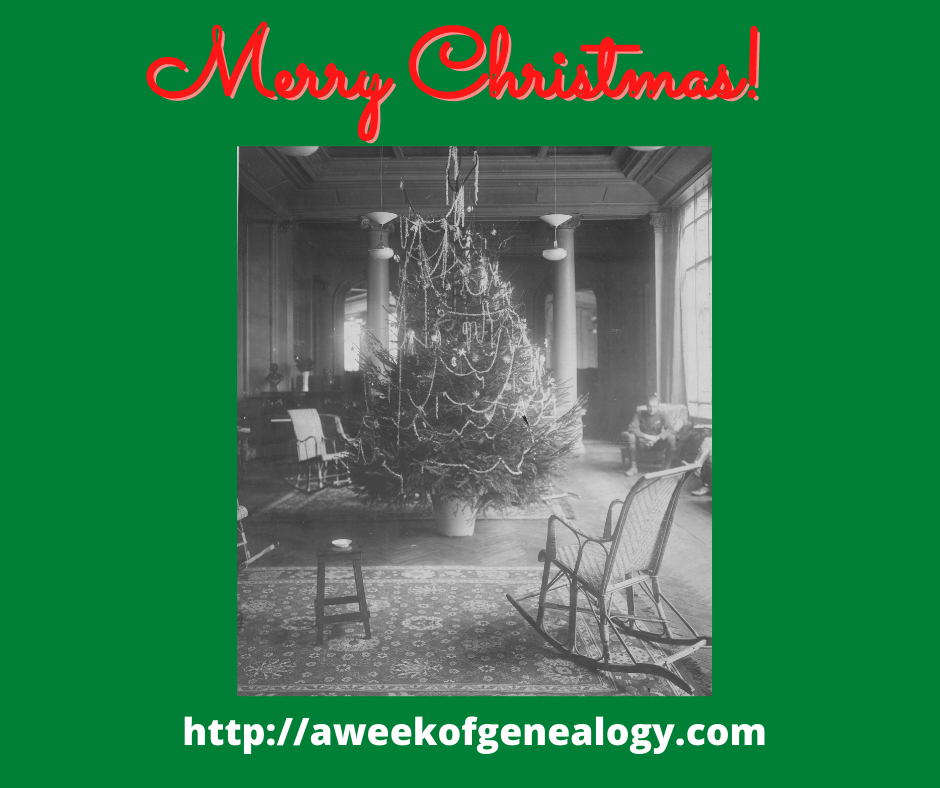
Merry Christmas WWI

Hello Everyone,

We hope this blog post finds you well and celebrating a happy and healthy holiday season.

This year brought Zoom classes, a class accepted by RootsTech Connect 2022, graduation from the amazing ProGen Study Group program, an archaeology class, more WWI research and a new book coming out soon.

So, stay tuned for more Zoom classes, books and more from us.

Here’s to what 2022 brings!

May all your weeks be filled with genealogy.

Genealogy at the Movies

There are many movies about families, and while they naturally put us in mind of genealogy, there are some movies where genealogists, or genealogy plays a major role.

Recently, I watched “On Her Majesty’s Secret Service”. In that movie, James Bond posed as a genealogist to infiltrate the lair of Ernst Stavro Blofeld, the head of SPECTRE. Blofield had been communicating with a London College of Arms’ genealogist Sir Hilary Bray in an attempt to establish his claim to the title of ‘Comte Balthazar de Bleuchamp’. James Bond poses as a knowledgeable and irresistible genealogist, with beautiful ladies more interested in seeing his genealogy book that we usually experience. Although there are many camps about who is the best Bond, this one starred George Lazenby as Bond.

“Murder on The Orient Express” always makes me think of genealogy. The connections between the passengers definitely needed a family tree as well as a chart of the Friends, Associates and Neighbors (FAN) Club. The connections to the child and the family were intertwined to the plot. Even people who connected to the family after the event became entwined with the plot.
The Star Wars movies are the ultimate genealogical movies. They encompass a truly large FAN Club, of a multitude of beings. For those family members who do not yet know they are interested in genealogy, teach them about family trees by sketching out Luke and Leia’s genealogy. Perhaps they will want to know how their own genealogy compares.