
Second Edition Now Available: Finding and Using U.S. Army WWI and WWII Morning Reports
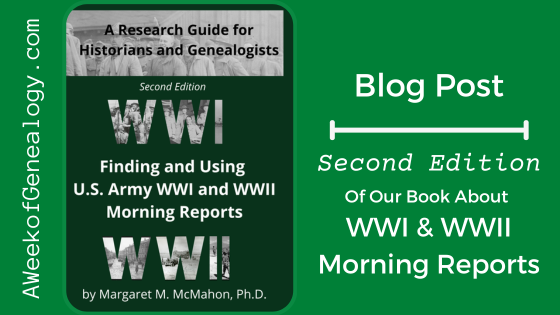
We’re pleased to announce the Second Edition of:
Finding and Using U.S. Army WWI and WWII Morning Reports
is now available on Amazon at: https://www.amazon.com/dp/B0HKV8X3B2
This Second Edition has arrived with updated guidance for finding, understanding, and using one of the most valuable sources available for researching U.S. Army service during World War I and World War II: Morning Reports.
The Second Edition includes major updates to two important chapters:
- How to find World War I Morning Reports using Fold3
- How to find World War II Morning Reports using the National Archives and Records Administration (NARA) Catalog
Morning Reports can allow you to travel back in time with a soldier or military organization, following locations, personnel changes, and events day by day.
For researchers dealing with Army personnel files lost in the 1973 National Personnel Records Center fire, Morning Reports can be especially valuable. They may help you overcome gaps left by burned personnel files, and, in some cases, help you reconstruct a soldier’s military experience in greater detail than a personnel file alone.
You can look for references to a specific soldier, but the real power of Morning Reports comes from following that soldier’s unit even on days when the soldier is not specifically named.
What You Will Learn
The book explains the formats used for WWI and WWII Morning Reports, the information they contain, and how those records changed over time.
Examples throughout the book introduce readers to the specialized language, abbreviations, and terminology used in WWII Morning Reports so that the records become easier to interpret.
Because locating Morning Reports is not always straightforward, the book also includes techniques for finding elusive reports, recognizing gaps in a record set, and developing strategies for working around missing records.
Going Beyond Individual Morning Reports
Morning Reports become even more useful when analyzed as a series rather than as isolated documents.
Case studies in the book demonstrate how reports from different parts of a military organization can be combined to reconstruct events.
These records place your soldier within the larger story of the military organization and the history unfolding around it.
For Genealogists and Historians
Genealogists can use Morning Reports to reconstruct military service when traditional personnel records are incomplete or unavailable.
Historians can use the same techniques to follow the activities and movements of military organizations through a world war.
The book also points researchers toward additional military records and sources that can help expand the story beyond what is contained in the Morning Reports themselves.
Bonus material covers reporting done by other military branches.
Finding and Using U.S. Army WWI and WWII Morning Reports Second Edition can be found in paperback using eco-friendly groundwood paper on Amazon at: https://www.amazon.com/dp/B0HKV8X3B2