
Aliens in Their Own Country, Stateless Women and AI
While researching the registration of aliens in the U.S. in 1940 and learning how to obtain an ancestor’s AR-2 form covered in Born in Brooklyn: An Alien in WWII, I wondered if other countries might have had similar laws at the time. (NOTE: This blog post is not intended as definitive, and is not intended as legal advice.)
I am always looking for resources to help to investigate topics. AI has become a resource to find and interpret credible sources. As a genealogical assistant, an AI can explain concepts to me and help me reason through how these laws applied to my ancestor.
The first sections describe the prompts I used, then a list of do’s and a couple of do not’s, with the last section summarizing what I learned about Canadian and British laws, and how they affected my ancestor.
I asked AI to help me research similar laws in other counties, specifically in Canada and Britain:
I am interested in learning more about women’s citizenship in Canada and UK when they married an alien
What followed was an informative conversation, where I asked for sources and clarification. ChatGPT provided relevant details and provided sources for the laws.
I then asked the AI to help me reason through how these laws affected my ancestor. Since these people have been dead for many years, I used initials. I could have used single initials or “Person 1” or “Person A” to be less precise. ChatGPT had asked if I had a specific woman I wanted to research, and this time I my prompt was a response:
K.S. (woman) was born in the U.S. and married J.Y. (man) born in Scotland. They married in New York City in 1913. J.Y. died in 1929. K.S. remarried in 1932 to J.G. (man) who born in the U.S.
ChatGPT outlined the timelines of the laws and how K.S. was affected by them, and asked for clarifications at times.
When writing the previous blog post I asked:
Can you find me a source that urged people who thought that they might be aliens to register in 1940? Give me the source. If you find a poster of flyer from the time, show me and of course, give me the source where it might be found
The response contains some very good sources for me to use, including the regulations published by the Department of Justice/Immigration and Naturalization Service published its Regulations Governing the Registration and Fingerprinting of Aliens in the Federal Register, including the section number.
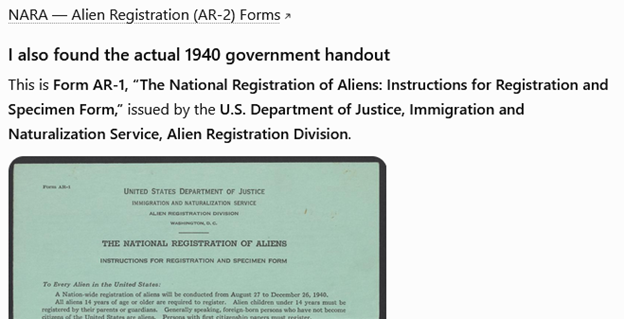
and The National Registration of Aliens: Instructions for Registration and Specimen Form,” issued by the U.S. Department of Justice, Immigration and Naturalization Service, Alien Registration Division.
Do
- Include in the prompt “Cite sources”
- Anonymize people’s names for privacy
- Ask for explanations of terms and passages that may not be straightforward
- Ask for help to find additional sources
Do not
- Hesitate to ask “Where in the document did you find this information”
- Forget about peoples’ privacy when using AI tools
What I learned about Canadian and British laws, and how multiple countries’ laws affected my ancestor:
Like much legislation, the laws surrounding women’s citizenship were complicated. Repeated subsequent legislation would later their status.
What I learned was that women’s situations were similar to the United States in Britain and Canada (although British law considered that there were other countries where a woman to automatically become a citizen of her husband’s country). The following is a simplified version covering some of the key events; you will want to dig farther into the details for your specific ancestors.
Britain’s Naturalization Act of 1870 tied a women’s nationality to her husband’s nationality. The British Nationality and Status of Aliens (BNSA) Act of 1914 explicitly stated, “the wife of a British subject shall be deemed to be a British subject, and the wife of an alien shall be deemed to be an alien.” The 1914 British Nationality and Status of Aliens Act allowed women who were widowed or divorced the status of British subject.
Until 1947 there were no Canadian citizens because Canadians were considered British subjects. That meant before 1947 a Canadian woman marrying a foreign national, became an alien. Before15 January 1932, a woman married to a man who naturalized became a British subject even if she was not named on his certificate, and a married woman who was a British subject lost her nationality if her husband became a citizen of another country. After 15 January 1932 a women marrying an alien lost her British nationality if her husband’s country considered her to be a citizen. In 1947, the Canadian Citizenship Act gave women separate citizenship that they retained separate from their marriage. The “Lost Canadians” did not have their citizenship returned automatically. It was legislation in 2009 that retroactively returned their citizenship. In 1948 UK women were given separate citizenship. (In 1947, a woman who married a Canadian did not automatically derive her citizenship from her husband.)
On 22 September 1922, the Cable Act repealed the 1907 Expatriation Act, and women no longer lost their citizenship based on their husband’s nationality. But for women married before then, the situation was more complicated. In 1936, divorced or widowed women could repatriate via an application, and upon its approval taking an oath of allegiance. As of 2 July 1940, an act allowed women to repatriate no matter what their marital status was. The repatriation oaths could be filed in any county, state or federal. They might be separate in a court’s naturalization records (as in Westchester County, NY).
Consider this situation pre-1932: a woman born in Canada (British subject) marries an American man in 1930. By Canadian law she loses British nationality. But after the U.S. Cable Act of 1922 did a foreign woman did not automatically become an American citizen when she married an American. This woman would be stateless, neither British, nor American.
The widowed Kathryn remarried in 1932 to an American citizen, so she did cease to be a British subject. Since this was after 1922, her marriage to an American citizen did not automatically make her an American citizen. Therefore, legally she may have been in limbo, neither British nor American. She may have been stateless at that time.
In 1933, the situation was remedied for Kathryn and other women in her situation. The British Nationality and Status of Aliens Act 1933 changed the rule. “Under the 1933 Act, a woman would not be deemed to have ceased to be a British subject automatically on marriage to an alien (or when, during the marriage, her husband ceased to be a British subject) if she did not actually acquire her husband’s nationality” (Resumption (History)). Retroactively, women in Kathryn’s situation, who had not gained citizenship through their marriage, regained their British subject status.
On 20 December 1940, Kathryn filed an Alien Registration Form, reporting her citizenship as “Great Britain” (without any notation in the margin that “Applicant doubts need for registration”).

Learning More
When Saying “I Do” Meant Giving Up Your U.S. Citizenship by Meg Hacker https://www.archives.gov/files/publications/prologue/2014/spring/citizenship.pdf
Historical background information on nationality (accessible), Updated 22 May 2023. https://www.gov.uk/government/publications/historical-background-information-on-nationality/historical-background-information-on-nationality-accessible
Resumption (History) [Archived]. https://assets.publishing.service.gov.uk/media/5a81dce5ed915d74e3400763/resumption.pdf
Ethnic Origin And Nativity Of The Canadian People, EIGHTH CENSUS OF CANADA, 1941. https://publications.gc.ca/collections/collection_2017/statcan/CS98-1941M-35-eng.pdf (See document pages 114–115 describing the national status of married women.)
Good luck with your research and let me know how you do!