
WWII Army Serial Numbers
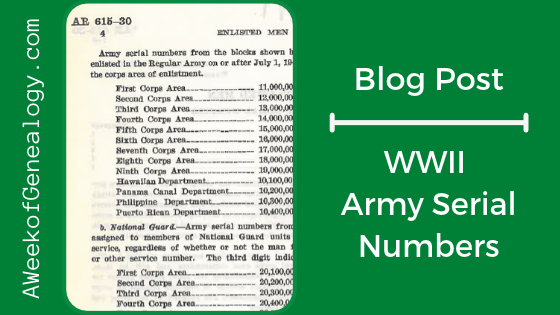
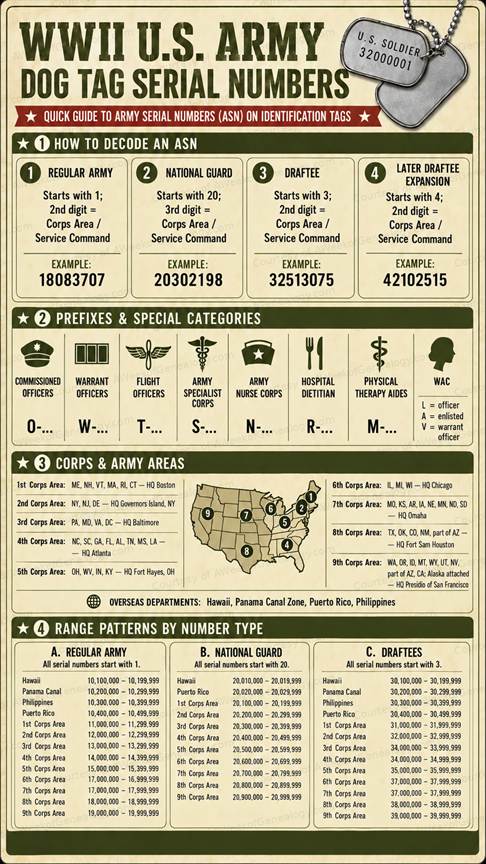
You already know that a WWII enlisted soldier’s Army Serial Number (ASN) is unique, but it can also reveal additional information. The first one or two digits can indicate whether the soldier served in the Regular Army, the National Guard, or was drafted. The next digit can identify the Corps Area or Overseas Department in which the soldier enlisted or was inducted.
The research for this post as been ongoing and detailed. This seemed a topic suitable for the week of Veteran’s Day.
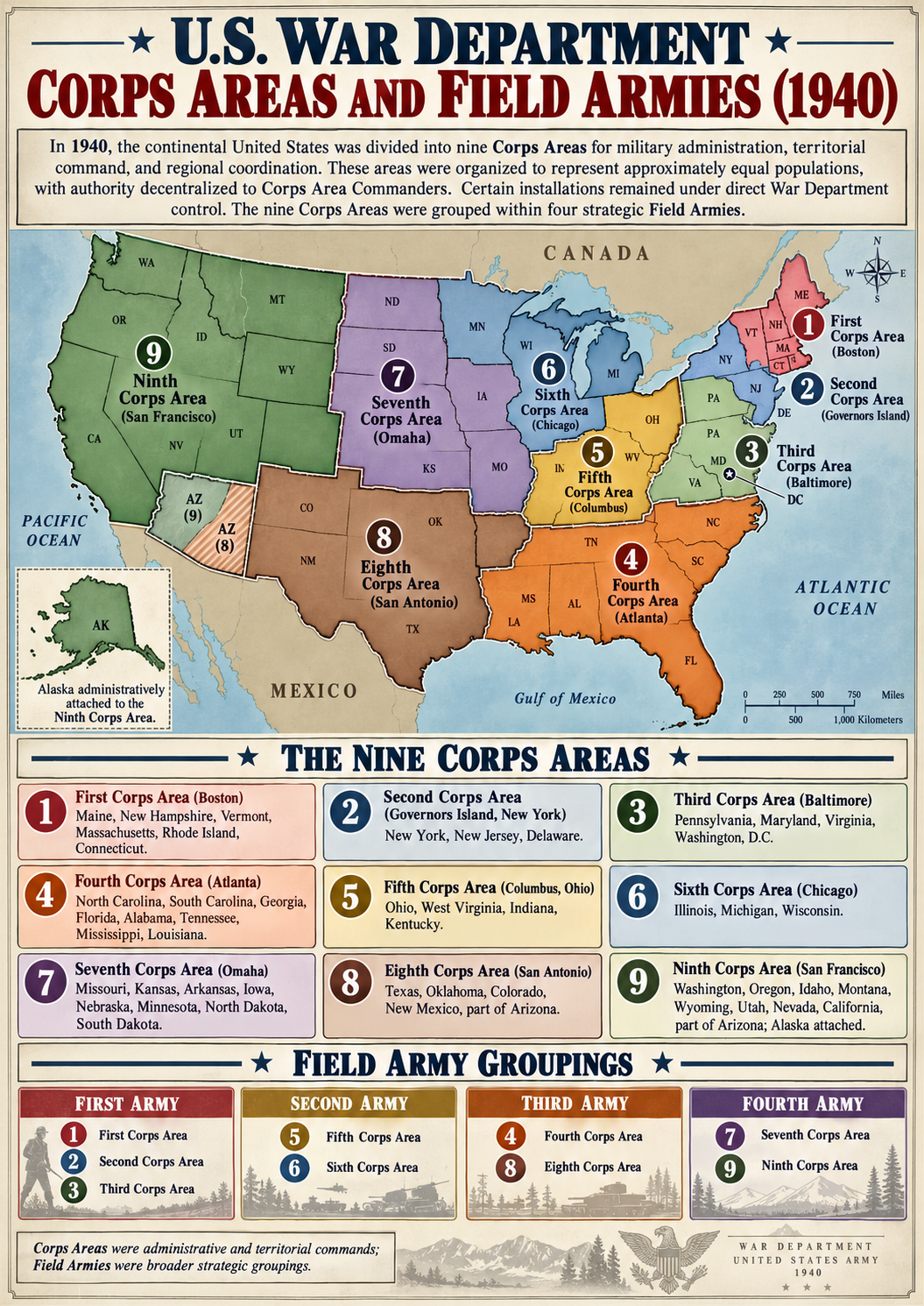
The Corps Areas and Overseas Departments
In 1940, the continental United States was divided into nine Corps Areas by the War Department had military administration, territorial command, and regional coordination. These areas were organized to represent approximately equal populations, with authority decentralized to Corps Area Commanders. Certain installations remained under direct War Department control. The nine Corps Areas were grouped within four strategic Field Armies. (The headquarters for each Corps Area is shown in parentheses.)
- First Army included the First Corps Area (Boston), covering the six New England states; the Second Corps Area (Governors Island, New York), covering New York, New Jersey, and Delaware; and the Third Corps Area (Baltimore), covering Pennsylvania, Maryland, Virginia, and Washington, D.C.
- Second Army included the Fifth Corps Area (Columbus, Ohio), covering Ohio, West Virginia, Indiana, and Kentucky; and the Sixth Corps Area (Chicago), covering Illinois, Michigan, and Wisconsin.
- Third Army included the Fourth Corps Area (Atlanta), covering eight southeastern states; and the Eighth Corps Area (San Antonio), covering Texas, Oklahoma, Colorado, New Mexico, and part of Arizona.
- Fourth Army included the Seventh Corps Area (Omaha), covering eight central states; and the Ninth Corps Area (San Francisco), covering nine western states, part of Arizona, and Alaska, which was administratively attached.
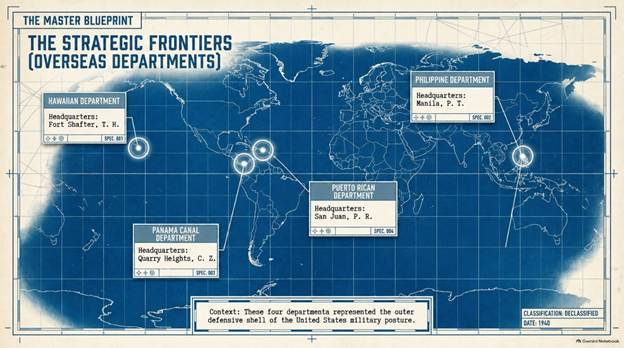
U.S. territories outside the continental United States were organized into four Overseas Departments: the Hawaiian Department (Fort Shafter, Hawaii), Philippine Department (Manila), Panama Canal Department (Quarry Heights), and Puerto Rican Department (San Juan). Each Overseas Department operated under a Department Commander responsible for territorial military administration and defense, except for installations controlled directly by the War Department. Unlike domestic Corps Areas, these departments could also assume civil responsibilities during emergencies.
Now that you know how to decipher the dogtag numbers, you can verify how the soldier entered the Army, and from which of the 9 Corps Areas and 4 Overseas Departments.
The Prefixes
If there is a prefix, you can determine if the soldier is an officer, a female, or that the soldier had a specialty.
There may exist other prefixes beyond what is shown in the infographic, but I am still hunting for contemporary sources for them. Without having those contemporary sources, CS- for contract surgeons, and for Army Scouts prefixes have been omitted from the infographic and tables.
Special thanks for their efforts and answers to questions go to: the Archivists at the Ridgeway Library at the U. S. Army Heritage and Education Center, and the Senior Historian at the Army Medical Department Center of History and Heritage.
Sources
NARA, “WWII Army Casualties: Utah,” https://www.archives.gov/research/military/ww2/army-casualties/utah.html
Smithsonian Institution, National Museum of African American History and Culture, “Identification tags worn by Lt. Louise Lomax,” https://nmaahc.si.edu/object/nmaahc_2022.42.3
United States. Office of Government Reports, Information Service. United States Government Manual: Fall 1940. https://www.govinfo.gov/app/details/GPO-GOVMAN-1940-09-01.
United States War Department, Enlisted Men: Army Serial Numbers, Army Regulations (AR) 615-30 (Washington, D.C.: War Department, 12 February 1942).