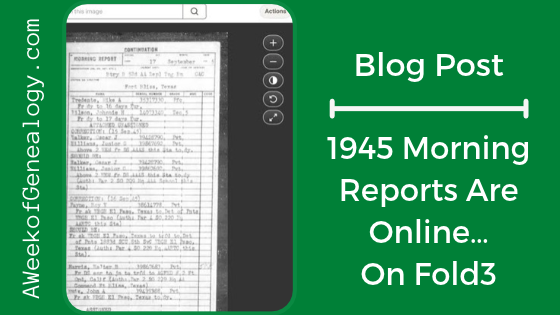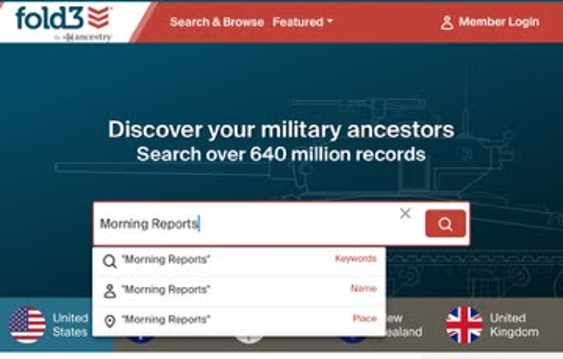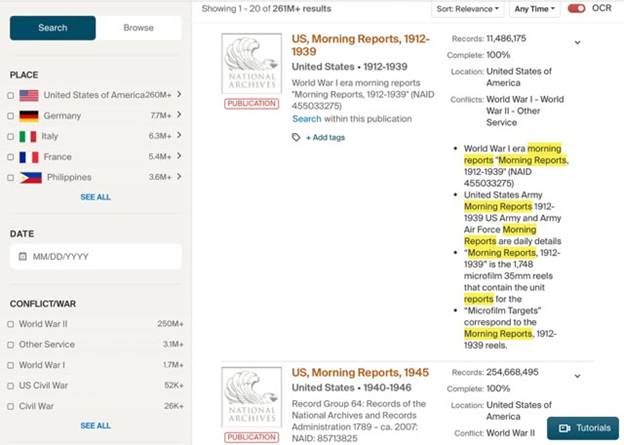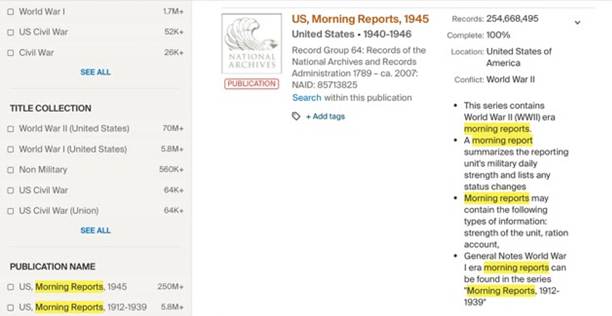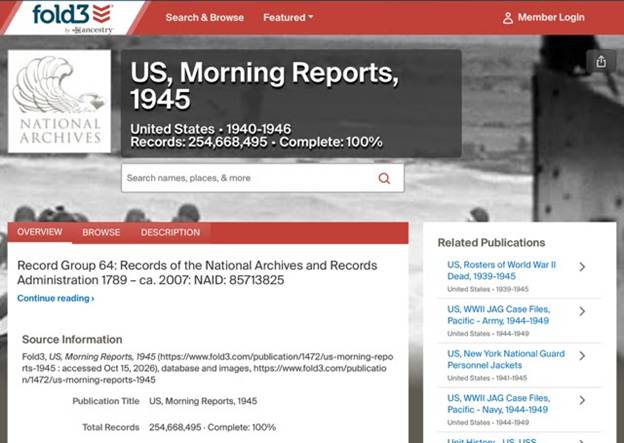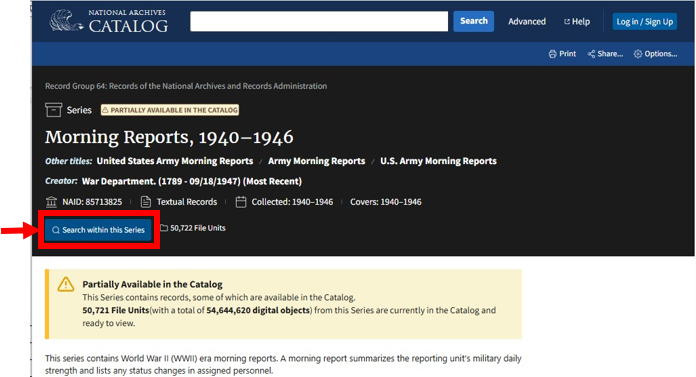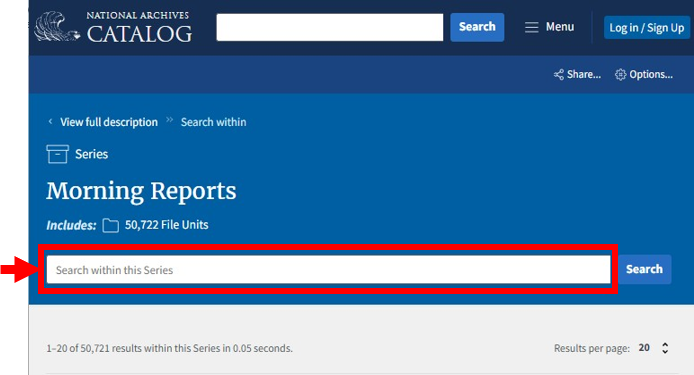
As a reminder, I search from the main catalog page at https://catalog.archives.gov/ so that I can benefit from the links to the search terms in the results. To see if more Morning Report are available I search for terms such as: “Morning Reports” AND “October 1944”
This time there were results! I kept searching, and Morning Reports up to December 1944 are available. (Search terms: “Morning Reports” AND “December 1944”) I did check for any from 1945, there were no results (yet!).
Of course, I did search for my father, by name and by serial number. This time I did find a mention of him. My brother was the first to know of this find, grateful that this was not a middle-of-the-night call!
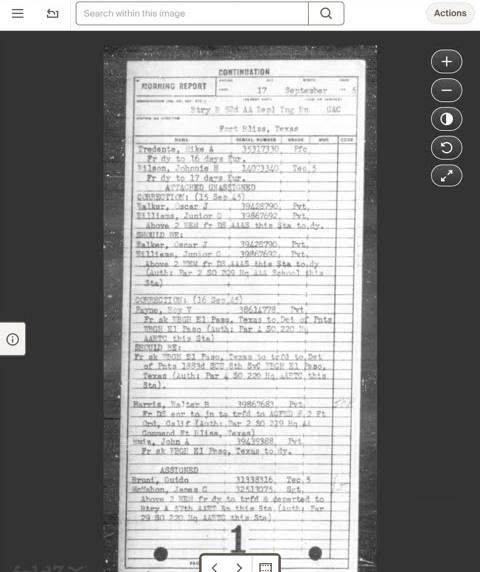
For tonight, I will share that SGT James C. McMahon appeared in a Morning Report for 13 October 1944, still in Narsarssuak, Greenland. July 1944 had left me with a cliffhanger, and this record provided data about two military organizations with which he served after the 500th AAA Gun Battalion left Greenland.
I will post about my continuing research as I use Morning Reports to reconstruct my father’s WWII service. From here, I will be busy moving forward and backward in time to track what was happening in Greenland.
Thank you to NARA! Good luck searching, and let me know how you do!
Remember that it is best to use a browser other than Firefox to see the image pages in order. If you choose to download the PDF file, know that it is over 1GB in size. You might want to read it online and download only the pages of interest.
My first stop for Civil War veterans is the Civil War Soldiers and Sailors (CWSS) database to learn what I could about his service and his organization. One surprise at CWSS was a note that: “This database is no longer maintained and updated.”
I searched for: “1st Regiment, New York Infantry” AND Kennedy, Thomas. There were three results. (I could have searched for Thomas Kennedy, then selected filters for Union and New York, and searched on results for 1st Regiment, New York Infantry.)
Thomas Kennedy was a Private in Companies A, F and G.
I clicked on the Battle Unit Name to learn more about the history of the 1st Regiment, New York Infantry, in the Civil War.
The second search result was an entry for Thomas McKinley contained a General Note that the original was filed under Thomas/Kennedy, and a Name Note – true name of soldier.
Then third result was for Kennedy, John. Although he might be related, I have no evidence. So I will just keep track of this.
Kennedy, Thomas 1st Regiment NY Inf Co G Invalid Pension Filed 11 Feb 1897 (Dead)
Over to Fold3 to search for military records there, I located three pension index cards for Thomas Kennedy. There was one each for the Companies in which he had served in the 1st Regiment, New York Infantry. Each card had the filing date of 11 Feb 1897 for an Invalid Pension, and the alias of Thomas McKingley. All three cards have been stamped “DEAD.”
Thomas McKingley’s Pension Index showed the alias Thomas Kennedy.
The next stop was the The New York State Military Museum and Veterans Research Center. They have a variety of online resources. I selected Unit History from the navigation menu, then the US Civil War, 1861-1865.
The 1st New York Infantry Regiment page had descriptions of the Regiment from two sources and gave me other information about its two years of service and the location where each of the companies mustered in and when.
Mustered in: April 22, 1861 Mustered out: May 25, 1863
The history of this regiment includes its service at Newport News, and discusses a noteworthy incident when Merrimac attacked the fortifications on March 8, 1862. Earlier in the war, USS Merrimac had been burned, captured and rebuilt as an ironclad warship, CSS Virginia. The Battle of Hampton Roads, where Virginia fought the Monitor in the Duel of the Ironclads, occurred on March 9, 1862. This story had captivated my son when he read Patrick O’Brien’s book, Duel of the Ironclads, in 1st grade. Finding out an ancestor was there was a big deal. We had visited the Mariner’s Museum in Newport News to learn more about CSS Virginia and USS Monitor as described in this blog postFamily History Outing: The Mariner’s Museum, Newport News, VA (where there was also some Pioneer Infantry history).
The page also contained links to other online resources.
The New York State Military Museum had a link to the Adjutant-General Report of the State of New York for the Year 1898. This report contained the register of the First Veteran Infantry, which included these two entries. They presented summary information without all the details found in the muster rolls.
At Ancestry.com, I looked at results in the New York, U.S., Civil War Muster Roll Abstracts, 1861-1900 database. The result for Thomas Kennedy contained 1st Inf for the Regiment, and with an explanation field: “see McKinley, Thomas.”
He was mustered into Company G, then was transferred to Company F.
He mustered in to Company F, then was transferred to Company A. There was a reference in the Remarks about his name being Thomas Kennedy, and a reference to a letter.
On the back of this page, a letter from the Record and Pension Office of the War Department had been attached. It has been determined that Thomas Kennedy was the true name of the soldier who had served as Thomas McKinley.
He was mustered into Company A after being absent with out leave from December 1862 until May 1863, but he was satisfactorily accounted for. In other Civil War records I had seen soldiers who were sick or wounded later rejoin their organization. Tracking these men after battles or while troops were moving was challenging.
With this information, I can create a timeline to compare events in the history of the 1st Regiment Companies with the time that Thomas Kennedy was with each company.
I went back to Fold3 to search for the Compiled Military Service Record (CMSR) Index.
The card for Thomas McKinley was a reference card pointing to the original filed under Kennedy, Thomas, the true name of soldier.
I know that I need to view the CMSR and the Pension file for the Rev. Fr. Kennedy to learn more about him and, hopefully, his family connections. So I ordered them through a NARA retrieval service.
Classification Lists show the results of the examination of the draftees, as well as where they were to be sent. Classification Lists are the Provost Marshal General’s Office (PMGO) Form 1000, that are found in NARA’s Record Group 163, the Records of the Selective Service System (World War I). As of this blog post being published, the Classification Lists at NARA are not available online.
The sections shown in each column header of the Classification List refer to the applicable instructions in the SELECTIVE SERVICE REGULATIONS, Washington, Government Printing Office, 1917. Although these regulations are not needed to use the Classification List, but they can be found at: https://www.google.com/books/edition/Selective_service_regulations_prescribed/6lB8dUkQtYIC?hl=en. Part X (ten) of this document contains blank forms.
Left-hand page of the ledger appears below.
The order number 2 is abbreviated, and is really 1792.
Right-hand page of the ledger shown is below:
0Going through a few highlights of the document.
The serial number shown in Column 4 (787) matches the one shown on the draft registration card.
The order number is shown in Column 1. It was the number in the national lottery for the draft assigned to that serial number.
The questionnaire to Joseph McMahon was mailed out on 2 Jan 1918, and was returned on 3 Jan 1918. (My reading suggests that these questionnaires no longer exist.) The notice of his physical exam of Class IA was mailed out on 29 Jan 1918. The notice to appear for a physical examination was mailed on 30 Mar 1918. He appeared for the exam on 1 Apr 1918, and the decision based on physical examination was mailed on 4 Apr 1918. He was told to report to his Local Board on 28 May 1918, at 8 a.m., for military duty and entrain for transportation to a mobilization camp. He was accepted at the mobilization camp on 30 May 1918. In the notes, were notes that may correspond to the fact that he was a Clerk in civilian life, he was inducted under General Call #385 and would be going to Camp Wadsworth. From columns without entries, I learned that he had not filed an appeal. He was not rejected or discharged at the mobilization camp.
After the Classification Examination, the registrant received a notice of their classification by mail. Note that they could file an appeal, and that would be recorded in the Classification List.
The registrants also received proof of their classification.
Thanks to Classification Lists, I now know what my grandfather was doing during several days of his life: filling in the questionnaire, going through a military medical physical, being notified of his date and place of induction, and his acceptance at the mobilization camp (and the fact that he was not rejected or discharged from there).
Thanks to Classification Lists, I now know about events during several days in my grandfather’s life.
Why you might want this record: to learn more about the process between an ancestor’s registration for the draft and induction, which might include indication that an appeal or deferment was made.
What you need to know before ordering: the draftee’s name and local draft board identification number, which can be found on the WWI Draft Registration Card for your ancestor.
Groups of men who registered for the draft and were determined to be in the Classification I category (based on filling in a questionnaire), were called in for physical examinations.
Classification Lists show the results of the examination of the draftees, as well as where they were to be sent. These lists are found in NARA’s RG163, and as of this blog post being published, the Classification Lists at NARA are not online.
I searched FamilySearch.org for Joseph McMahon’s WWI Draft Registration Card at https://www.familysearch.org/en/search/collection/1968530
The identification code for Joseph McMahon’s local draft board is circled. This number is used by the NARA archivist to identify the book for the Classification List containing Joseph McMahon’s entry.
Courtesy of FamilySearch.org
I emailed this information with an attached image of his draft card to the NARA branch in Atlanta at: atlanta.archives@nara.gov
An automated response was sent to my email in reply. Shortly after that, a response from an archivist followed with confirmation that the record had been found, and how to pay for it. The cost was $20. The scanned record was emailed to me after the archivist confirmed the payment.
Human archivists are involved in the process of lookup, scanning, and communicating. That means the timeline for responses may vary based on archivists’ workload. Also know that payment must be verified before the record is emailed.
In the next blog post, we will take a look at the Classification List itself.
Special thanks to Peggy Ash and Michael Strauss for their informative, detailed, and motivating presentations about the US Drafts.
While hunting for the rest of the Morning Reports for Battery A, 500th AAA Gun Battalion, I located a different format of the original roll, that offered a different option for downloading. (You can read how I searched for and download the Morning Reports of the 500th AAA Gun Battalion for September 1943’s at WWII Morning Reports using the NARA Catalog).
The interesting thing about these Morning Reports is that June and July for the same organization were filmed sequentially. This makes me curious if the reason may be related to the redesignation of the Battalion on 8 June, when the Coastal Artillery (CA) Battalions were redesignated Antiaircraft Artillery (AAA) Gun Battalions.
There was another surprise in store: these records could be downloaded in PDF files containing chunks of the Roll. (That means you do not have to download these one-page-at-a-time!)
I have been going through the results to determine if they relate to the Battalion that I am researching.
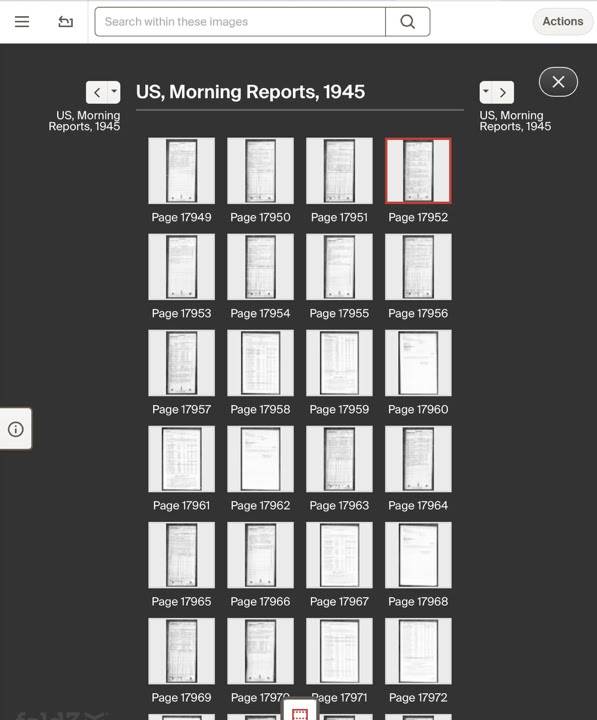
This took me to Image 1 (of 640). Not the links next to the thumbnails.
The links on the right side are navigation to the results.
I clicked on the link for Image # 643.
Even though my browser was not loading the PDF file, this page was different than others I had found. It had an option to download the PDF file.
Image # 644 looked familiar to me, based on the Morning Reports I had viewed for this organization. It was a page indicating the previous name of the organization before it had been redesignated.
The above image is the thumbnail view of the image below.
Of course, I downloaded the PDF file.
The filename was one of the 30 listed below the image, 85713825_1940-01-thru-1943-07_Roll-0711-04.pdf
Rather than have to download each image separately, the downloaded file contained the Morning Reports for June (beginning on 8 June) and July 1943 for Battery C, Battery D and the Medical Detachment of the 500th AAA Gun Bn.
The pdf files present the Morning Reports in chronological order, rather than the way the images are presented counting down (in the order they were photographed on the original roll).
Since this filename with -04 on the end suggested it might the 4th piece of Roll 711 (4 of 4), I took a chance and downloaded the file with -03 on the end.
Page 5 of the pdf had my answer! This file contained the Headquarters Battery of the 500th AAA Gun Bn
Both of these PDF files contained 125 images, so I know that when I locate these downloadable files in future, I will probably have to locate the rest of the organization by checking the files before or after the one that I am viewing.
Although I am not yet sure what triggers the conversion of individual images to being grouped together into PDF files for an organization, I will continue to look for these records and ask questions.
Minor update: I have located with two links Morning Reports for the 500th AAA Gun Battalion for June and July 1943, with each link leading to a page with a different type of file to download. One link is for downloading individual TIFF file downloads of each page, the other is for downloading PDF files.